
Personalized Outbound Strategy
Get The Right Outbound Strategy In Minutes
Enter your email to get a custom plan & stack recommendation for your business
It's being carefully crafted by AI
Please check your mailbox in 5 minutes

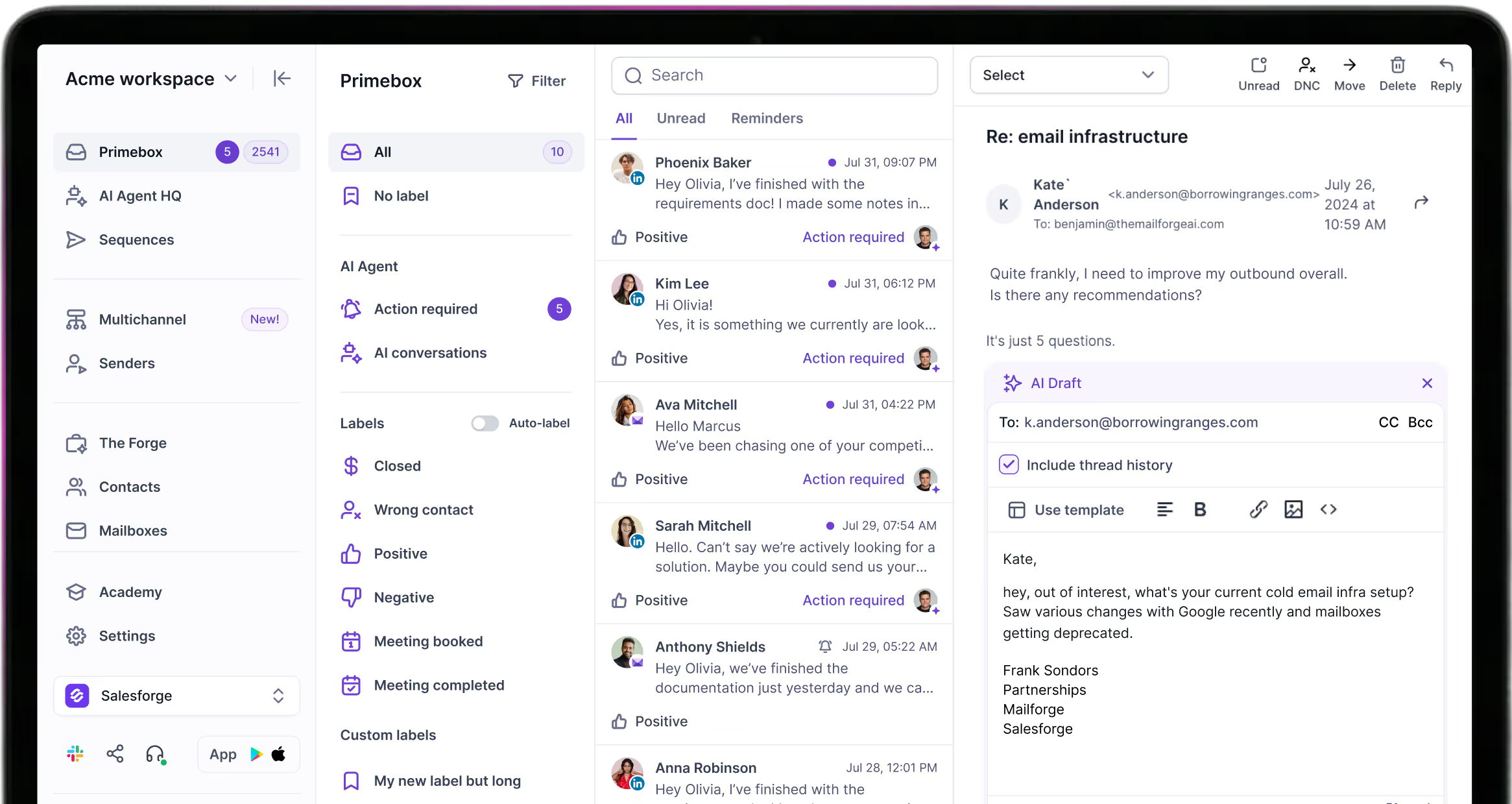
For a thorough understanding of what each option offers, a simplified comparison table isn't enough to grasp all intricacies that come with each tool, so let's dive deeper into what makes Persana's Nia and Salesforge's Agent Frank unique.
At a surface level both products pitch the same core value: an AI agent that automates outbound SDR work so sales teams get more meetings and more deals.
Persana’s Nia positions itself explicitly as a 24/7 AI Autopilot SDR that can “automate up to 90% of your sales development process." It emphasizes access to a huge contact database and multi-channel engagement.
Salesforge takes AI SDRs to the next level.
Agent Frank, built by a former Googler and VP of sales, is a turnkey solution within a tightly integrated suite (The Forge Stack) - designed to run on auto-pilot and reduce all manual tasks that typically burden SDRs.
Still doubtful? Agent Frank's results speak for themselves

Both pitch around scale prospecting, personalized outbound, and freeing reps for strategic work, but the packaging and operational model differs:
Agent Frank provides flexible pricing oriented around outreach scale. Pricing is charged by Active Contacts (the number of prospects the Agent is processing at any given time), and annual billing includes 2 months free. There is no free trial and demos are required before purchase.
Note that infrastructure to process those contacts via email is not included in this base price. Recommended infrastructure options include:
The Forge team will help set up the mailboxes and the Mailforge (shared IP) and Primeforge (Gmail and Outlook) email infrastructure options are also available. Additionally, teams can connect their own mailboxes from other providers if desired.
Nia, on the other hand, requires contacting sales for a pricing figure.
For teams that live and die by intent signals, contact data quality, and the ability to access major data sources, Persana’s message is simple and loud:
That breadth of data sources and emphasis on real-time intent signals and job postings makes Persana attractive when your GTM intelligence strategy needs comprehensive signal intelligence and deep enrichment across many data points.
On the other hand, Salesforge sells a different approach to data and enrichment:
That means fewer disconnected data flows, less waterfall data across multiple enrichment providers, and fewer manual triggers to stitch enrichment outputs into outreach workflows.
Additionally, Agent Frank supports various intent signals and allows uploading as many custom data sources as needed.
Deliverability is the linchpin of cold outreach success, and this is one area where Agent Frank intentionally differentiates itself.
And more. Building sender reputation gradually while spreading volume across addresses and IPs to avoid single-mailbox throttles or sudden reputation hits is crucial for a scaling business. And that's paired with proprietary infrastructure options:
Those infrastructure features reduce the risk of landing in spam and make multi-channel outreach more reliable, especially when you have a leads database and want to integrate email at scale.
For sales teams or lead generation agencies focused on large scale operations and high-volume cold outreach, the difference matters. Agent Frank’s model minimizes the operational burden of maintaining email metrics, domain health, and warm-up cycles so teams can scale sends across many mailboxes with less risk.
Enter your email to get a custom plan & stack recommendation for your business
Please check your mailbox in 5 minutes
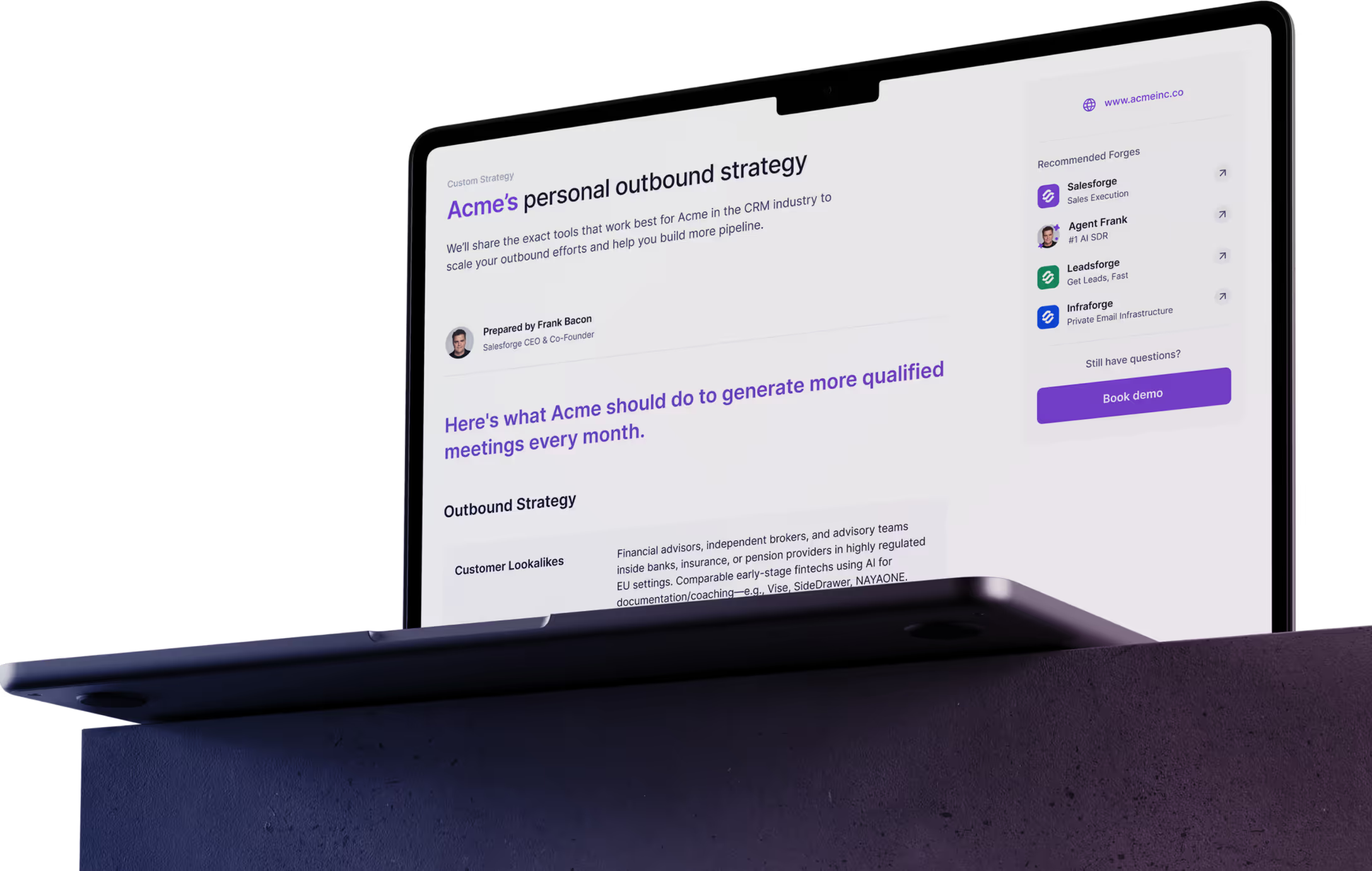
Personalized outreach is no longer “nice to have” - it’s fundamental.
Salesforge’s Agent Frank takes it a step further.
That multi-source hyper-personalization matters for sales leaders worried about brand voice, compliance, or nuanced positioning.
Instead of relying purely on open web signals, Agent Frank’s knowledge-base approach reduces surprises and ensures your company’s voice is baked into every message.
For many sales teams the best result is a hybrid - strong external signals plus a company knowledge base - and Agent Frank’s setup explicitly enables that.
The onboarding and support experience matters - the faster you move from sign-up to outbound, the quicker you see ROI.
That approach reduces the manual tasks sales teams often struggle with - no separate deliverability vendor, fewer manual data entry steps, and a partner focused on ironing out initial list hygiene and infrastructure.
Besides that, Agent Frank customers also get:
For growing sales teams and lead generation agencies that prefer to shift heavy operational overhead away from internal staff, Agent Frank’s Account Manager model is a strong fit.
They offload the manual tasks that consume SDR time and let reps focus on higher-value activities like closing deals and handling qualified leads.
Those elements signal an enterprise-grade onboarding path focused on consolidating major data sources and real-time intent signals, but Agent Frank’s support is engineered to remove overall friction in execution.
Salesforge’s model scales in a different, more practical way.
That approach addresses a very real pain point.
Many teams hit workflow ceilings not because they lack contacts, but because their tech stack forces manual research, verification, and deliverability management - tasks that create hard limits on how far you can scale without adding headcount.
But if your team does have a high headcount, Agent Frank additionally offers unlimited LinkedIn senders, unlimited mailboxes, unlimited workspaces, and even unlimited seats.
Agent Frank’s tighter stack reduces those hard limits and gives teams a cost-effective path to scaled systems without the overhead of managing a waterfall of enrichment and phone numbers from disparate providers.
Both Nia and Agent Frank are formidable AI SDR offerings with overlapping strengths: automated outreach, personalization, and the ability to increase meetings.
Persana’s strengths are clear and factual - massive data reach and playbooks that help modern GTM teams access comprehensive signal intelligence and replace fragmented point solutions.
Agent Frank’s strengths are, for many teams, more immediately impactful: a purpose-built Forge Stack that eliminates many of the operational headaches that accompany scale:
Those concrete capabilities reduce disconnected data, manual research, and the need to stitch together multiple enrichment providers and outreach tools - exactly the pain points that create workflow ceilings and hidden costs.
Agent Frank emphasizes an integrated, autonomous platform and agent layer that runs prospecting, deliverability, and outreach end-to-end. Persana AI and many AI research agents lean on massive data and multi-agent architecture to surface signals. Persana consolidates lots of external signals; Agent Frank combines that signal approach with a fine tuned model plus controllable knowledge-base so messages aren’t driven by not predefined rules alone. For teams who want a managed, brand-safe autonomous agent that still supports experimentation, Agent Frank balances autonomy with guardrails.
Yes - Agent Frank supports native CRM integration and bi-directional sync to keep CRM data current and feed revenue operations. That means automated enrichment updates, closed-loop reporting, and coordinated sequences across your entire GTM stack. The result: streamlined workflows, improved sales productivity, and fewer manual handoffs between marketing, SDRs, and ops.
Agent Frank is designed to reduce platform limits and lower the learning curve: managed onboarding, a Dedicated Account Manager, and ready-made playbooks help teams break free from fractured tooling. While Persana consolidates massive datasets (which can introduce complexity), Agent Frank aims to be cost effective and plug into existing stacks quickly (including a Chrome extension for outreach workflows), minimizing friction so you see value faster.
Agent Frank applies AI enrichment from multiple sources plus your uploaded knowledge base to create hyper-personalized outreach and AI email writing. The agent layer generates actionable insights - sequence performance, cadence tweaks, and message variants - so reps can optimize follow-ups and scheduling to drive more meetings and better sales conversations.
Agent Frank scales via an autonomous platform (auto-pilot and co-pilot modes) without needing a separate multi-agent architecture or extra headcount. It’s pitched as cost effective for growth-focused teams: fewer tools to manage, clearer reporting, and faster ramp to more meetings. If your GTM strategy is tied to race capital or recent funding rounds, Agent Frank can help you scale outreach predictably while your ops team focuses on closing deals.