
Personalized Outbound Strategy
Get The Right Outbound Strategy In Minutes
Enter your email to get a custom plan & stack recommendation for your business
It's being carefully crafted by AI
Please check your mailbox in 5 minutes


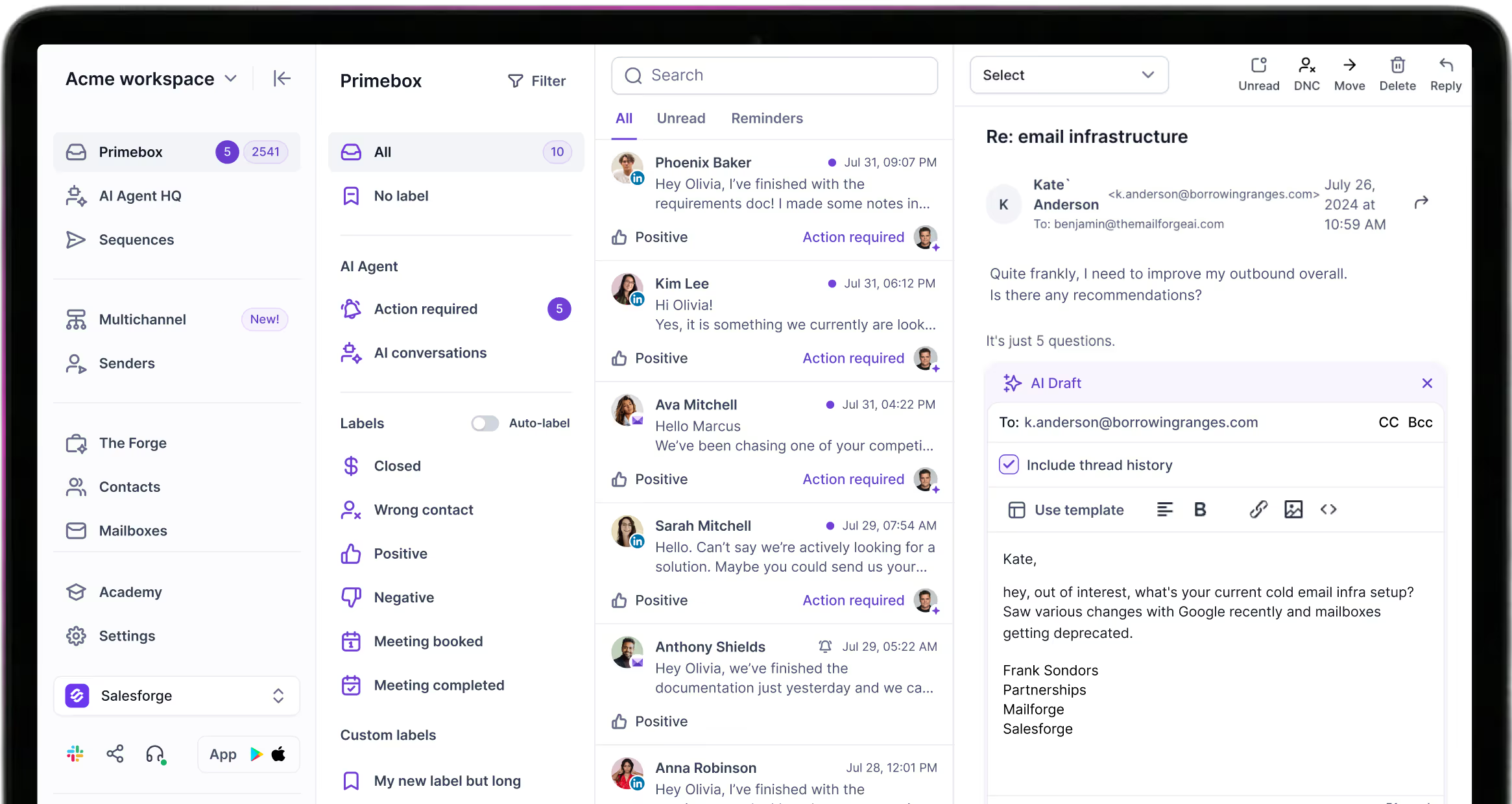
Each product has a clear orientation. Salesforge is built as a multi-channel cold outreach platform focused on email deliverability at scale plus LinkedIn sending capability, aiming to make email your primary outreach channel while supporting LinkedIn outreach as a volume channel.
Waalaxy positions itself first as a LinkedIn prospecting and automation engine with email enrichment and cold emailing as complementary - ideal if LinkedIn is your primary outreach channel.
Octopus CRM is squarely a LinkedIn automation tool (connect, message, view, endorse) with “connect by email” as a workaround for higher connection volumes.
If your outreach strategy centers on blended, deliverability-first email plus LinkedIn sequences, Salesforge, built by a former Googler and VP of sales, is designed around that use case; if you want native, lightweight LinkedIn automation, Waalaxy and Octopus CRM are very strong choices.
If you're still doubtful, feel free to let the results speak for themselves:

A binding constraint for cold outreach is how many distinct senders and mailboxes you can operate:
For complex prospecting campaigns that purposefully spread sending across domains and many mailboxes, Salesforge’s approach gives a direct operational advantage for deliverability and campaign performance.
Cold outreach success is won or lost by inbox placement - avoiding the spam folder is crucial for effective cold emailing. Salesforge emphasizes premium email deliverability:
Waalaxy supports sending emails but both are primarily LinkedIn automation tools first - they help enrich and sync email addresses yet don’t foreground enterprise-grade warm-up, reputation monitoring, or integrated deliverability tooling in the same way.
Waalaxy and Octopus CRM excel at LinkedIn campaigns - invitations, profile visits, connection acceptance flows, and multi-step LinkedIn sequences:
Salesforge targets both email and LinkedIn but is purpose-built for multi-channel campaigns where the heavy lifting is automated email sequences and deliverability at scale, supplemented by LinkedIn senders.
Follow ups and message scheduling are the heartbeat of cold outreach.
Waalaxy provides built-in scheduling and automatic follow-ups within LinkedIn and email flows; you can save templates and schedule reminders in the inbox.
Octopus CRM includes automated follow-ups and the ability to sequence messages to 1st-level connections.
Salesforge provides automated sequences and centralized control of follow-ups across mailboxes and LinkedIn senders, with a particular emphasis on matching cadence to deliverability constraints (daily limits, warming rules) so automated email and LinkedIn sequences don’t inadvertently harm the sender's reputation/profile.
Importing leads and keeping prospect lists clean is critical for any outreach tool:
For teams running complex prospecting campaigns with multiple lead sources, Salesforge’s integration focus and dashboarding reduce operational friction.
Enter your email to get a custom plan & stack recommendation for your business
Please check your mailbox in 5 minutes
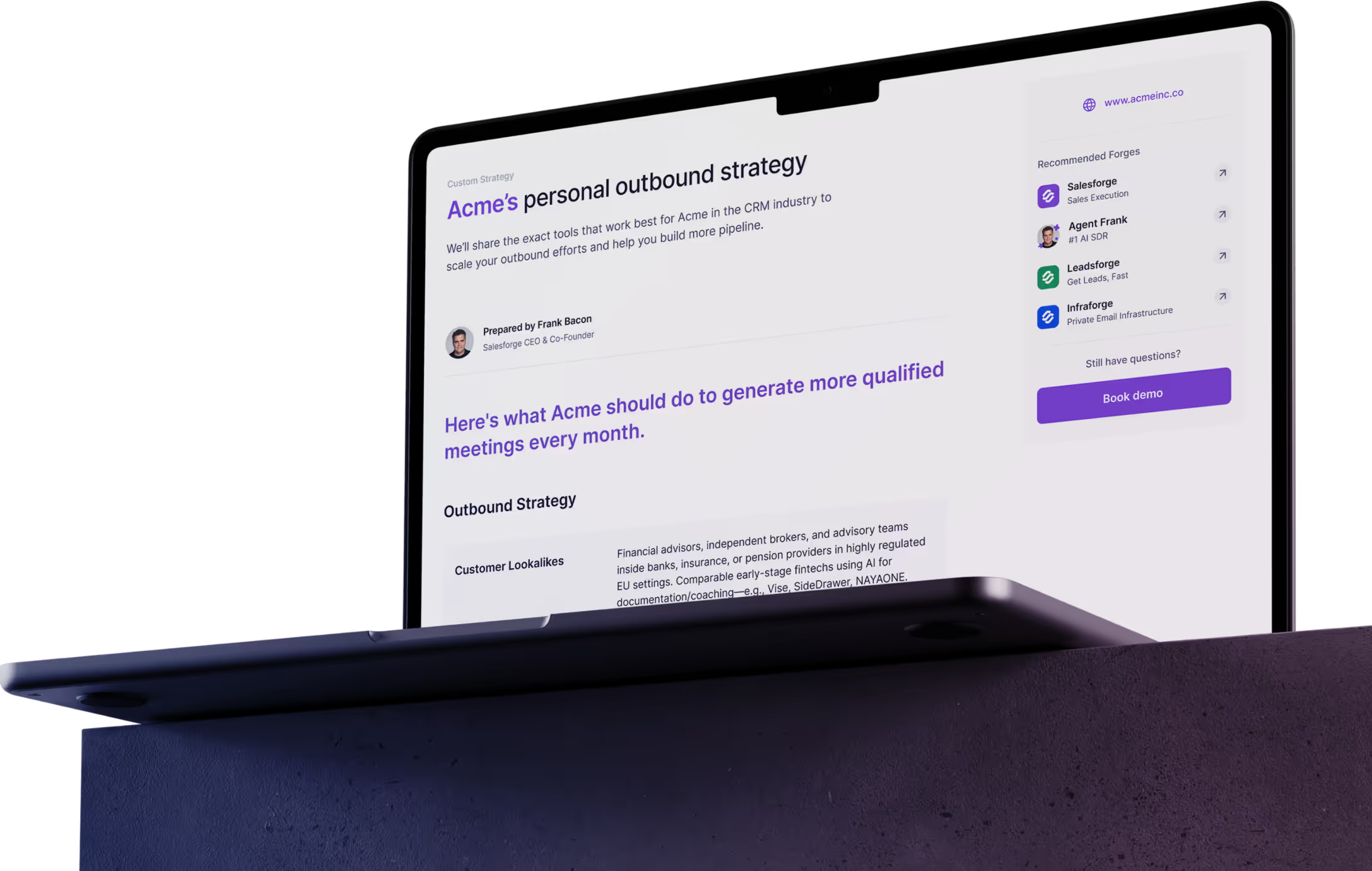
Finding accurate professional emails is essential before you run automated email sequences.
Waalaxy includes an integrated email finder to enrich leads with pro emails and explicitly supports including the email finder in campaigns, which simplifies multichannel sequences (LinkedIn + email).
Octopus CRM doesn’t build a native email-verification/finder product on its marketing pages the same way.
Salesforge positions itself as a platform that plugs into lead-making workflows and integrates with lead enrichment tools, so while it may not market “email finder credits” the same way Waalaxy does, Salesforge’s architecture favors high-quality enrichment pipelines before sending - an important nuance when you plan personalized email campaigns.
Waalaxy and Octopus CRM both offer template systems and support personalized fields for first names, company names and basic personalization in connection requests and messages. Waalaxy even includes AI assistance to draft messages and templates among 50+ customizable templates.
Salesforge, on the other hand, supports AI personalization at scale for email sequences and LinkedIn outreach while tying personalization to deliverability and mailbox health.
For outreach that needs high degrees of per-recipient personalization but also consistent delivery, Salesforge balances both sides.
The most effective outreach strategies today are multichannel: LinkedIn invitations plus personalized email follow ups:
Waalaxy explicitly advertises LinkedIn, cold emailing, and an “and/or” approach to campaigns - you can run LinkedIn and email steps in the same sequence.
Octopus CRM provides strong LinkedIn funnels, but that's about it. It is predominantly LinkedIn-centric.
Salesforge is built as a multichannel outreach platform that prioritizes email deliverability while enabling LinkedIn at scale - the result is a workflow optimized for personalized email campaigns backed by LinkedIn touchpoints where appropriate.
Knowing campaign performance (open rates, reply rates, acceptance rates) is essential:
When campaign performance and mailbox health are tightly coupled (so you can adjust cadence to protect deliverability), Salesforge’s dashboard and monitoring tools give you leverage to maintain consistent long-term inbound results.
Cold outreach becomes chaotic if replies land in many places.
Salesforge provides centralized reply management (a unified inbox that captures replies across email and LinkedIn even if prospects reply from a different address), which helps reduce lost conversations and ensures follow up.
Waalaxy offers an enhanced LinkedIn inbox with tagging, scheduling and auto follow-up, while Octopus CRM focuses on the automation funnel and leaves reply management to either your LinkedIn inbox or exported workflows.
Keeping LinkedIn accounts safe is crucial. Both Waalaxy and Octopus CRM emphasize safe automation:
Salesforge’s approach to LinkedIn sending focuses on volume management across many senders so each account operates safely at lower per-account volumes, which in practice preserves acceptance rates and reduces account risk as you scale.
Waalaxy markets AI-assisted prospect search and message drafting, many prebuilt campaign templates, and integrations via Zapier/Make.
Octopus CRM exposes funnel building, skill endorsing and connect-by-email, and different pricing tiers with added campaign capacity for higher plans.
Salesforge places value on advanced delivery controls, large-scale sender management and an API for programmatic control - features aimed at teams who need to run complex prospecting campaigns across many mailboxes and senders without losing deliverability.
When your needs demand advanced features tied to mailbox and domain reputation as part of campaign setup (not just campaign steps), Salesforge is especially focused on that class of capability.
Waalaxy highlights integrations with CRMs and the ability to sync leads with HubSpot, Pipedrive and many apps through Zapier/Make.
Octopus CRM advertises only Zapier and HubSpot integrations to push data.
Salesforge emphasizes that it’s easy to plug into popular CRMs and lead generation tools and highlights an API and workflow integrations for programmatic send control and data flows.
Octopus CRM lists multiple pricing tiers from low-cost starter plans (from $10/mo) up to agency/unlimited options, making it affordable for LinkedIn-first prospectors.
Waalaxy offers "start for free" onboarding and scales into team/enterprise plans for multi-user prospecting, though actual paid plans start from ~$46/mo (when converted from euros).
Salesforge positions itself toward teams and agencies that require strong deliverability and mailbox management; its value isn’t just in sticker price but in the infrastructure that reduces cost per acquisition by improving inbox placement and reply quality, though the pricing is relatively lenient (from $48/mo) with the Growth plan for unlimited LinkedIn senders and email mailboxes starting from $96/mo without discounts.
Waalaxy or Octopus CRM are excellent picks when your primary outreach channel is LinkedIn and you want straightforward, fast automation for invitations, messaging, profile visits and team prospecting without deep email infrastructure needs.
If your outreach strategy relies on AI hyper-personalized campaigns, automated sequences, consistent follow ups, message scheduling, extensive analytics, 24/7 support, robust integrations and managing multi-channel campaigns in one convenient dashboard, Salesforge is the best tool among the three.
Its emphasis on premium email deliverability, the ability to manage unlimited mailboxes and LinkedIn senders positions it as a platform perfect for more complex prospecting campaigns and scaling outreach without sacrificing inbox placement, while the user-friendly interface and affordability position it as a perfect option for smaller teams as well.
Deliverability is a stack problem - domain setup (SPF/DKIM/DMARC), sender reputation, sending cadence, and warm-up strategy all interact. Salesforge’s server-side warm-up and monitoring can automate much of that lifecycle (reducing manual warm-up work) and surface issues earlier. Regardless of vendor, you should watch bounce rate, spam complaints, and engagement metrics and tie those back to list hygiene and your automation tools’ sending policies.
Yes! AI personalization + custom sequences can lift open and reply rates by making messages more relevant, improving campaign performance. Salesforge’s approach (AI message generation combined with server-side sequencing and deliverability controls) can scale personalization while enforcing throttling, A/B testing, and inbox rotation to mitigate risk.
Enterprises value reliable integrations, governance, and auditability. Salesforge often markets native connectors, webhooks, and an API that make it easier to integrate with CRMs and Sales Navigator-sourced lists without manual CSV exports; this simplifies lead generation workflows. Trade-offs include vendor lock-in (deep integrations can be harder to migrate away from), potential incremental cost for high volume, and a need for initial onboarding/technical setup.
Browser-extension tools execute actions from a user’s machine, which can mimic human interactions but are vulnerable to local network/IP exposures and require the client to keep a browser session running. Salesforge (cloud/server-side) can offer controlled IP pools, scheduled throttling, account rotation, and centralized policies that reduce risky linkedin activities at scale. In the LinkedIn automation space, cloud platforms can more consistently enforce safety rules (daily quotas, randomized delays, smart sequencing) across users.
Salesforge often provides richer cross-channel dashboards than browser extensions, exposing conversion funnels, deliverability health, and sequence-level outcomes that support basic attribution across LinkedIn and email. For many teams this built-in reporting is sufficient to optimize sequences and measure campaign performance. However, for enterprise-grade attribution (multi-touch, revenue impact, customer lifetime value correlation) you’ll want to export event data (via webhooks or API) into a BI/analytics stack to join with CRM/opportunity data.