
Personalized Outbound Strategy
Get The Right Outbound Strategy In Minutes
Enter your email to get a custom plan & stack recommendation for your business
It's being carefully crafted by AI
Please check your mailbox in 5 minutes


At a glance, the two platforms aim at nearby but different problems.
Where PhantomBuster’s core is data collection and enrichment for lead generation engines (akin to Leadsforge - another tool in the Forge Stack), Salesforge’s core is pipeline orchestration that tethers good email infrastructure to LinkedIn processes and reply handling. You can let Salesforge's results speak for themselves:

Salesforge provides 2 plans oriented around outreach scale, as well as a 14-day free trial.
The plans are as follows (with 2 free months granted when using annual billing):
PhantomBuster provides 3 plans oriented around automation scale and a 14-day free trial too. (with a 20% discount when using annual billing):
If your primary requirement is extract data from social platforms, build lead lists, enrich contact data and feed it to an outreach system or CRM, PhantomBuster is explicitly designed for that use case.
PhantomBuster calls out the ability to pull data from more than a dozen platforms, keep that data fresh in real time, and enrich lists with thousands of data points so you can match ideal customer profiles precisely. That makes it good for teams that need to generate lead lists and push enriched contact data into their sales pipeline.
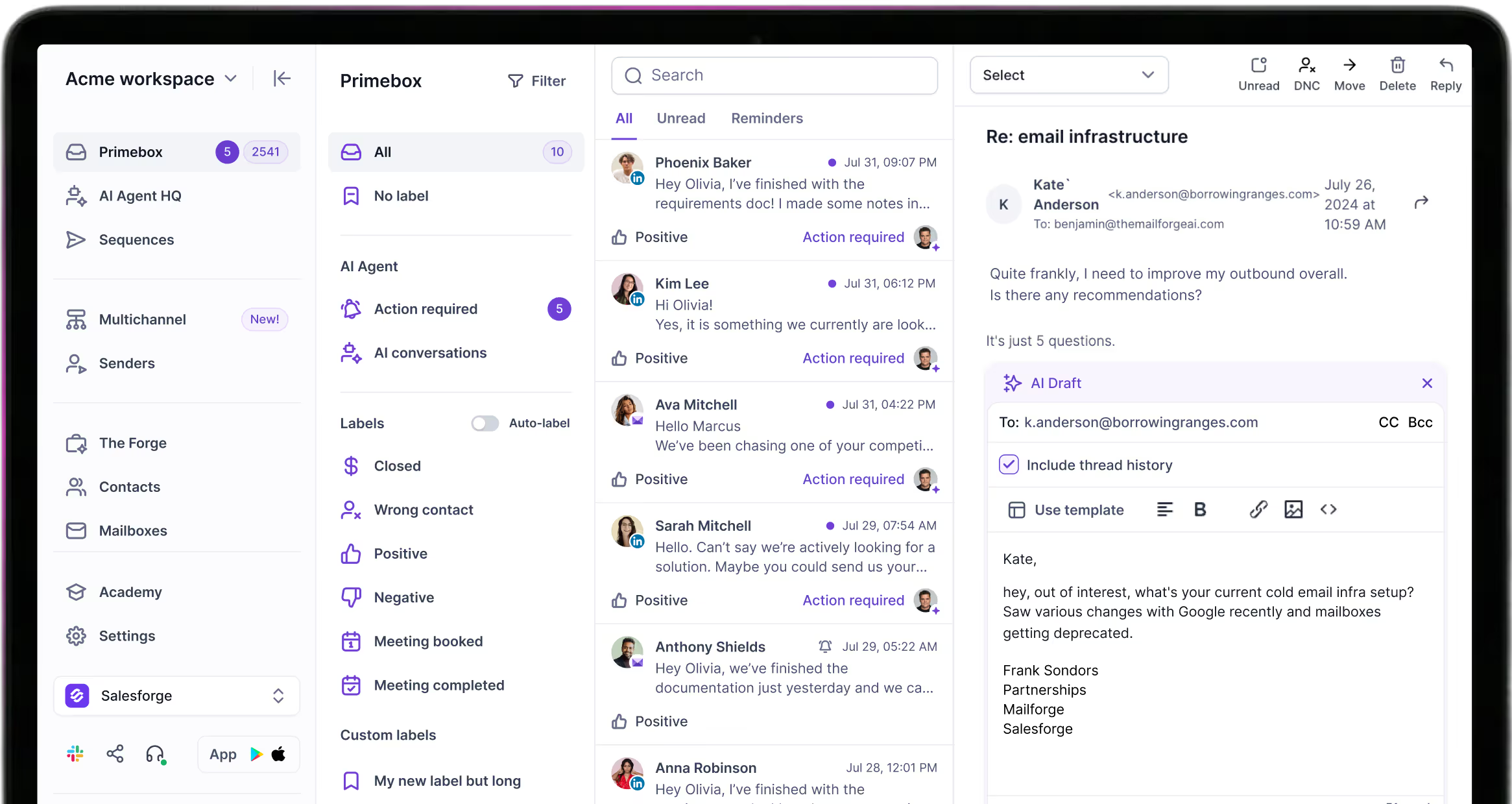
Salesforge, by contrast, is more pipeline-focused: it bundles email infrastructure and warm-up, unlimited LinkedIn senders, and a unified inbox (Primebox) so teams can orchestrate multichannel outreach and manage replies without losing context.
Many teams use PhantomBuster to generate and enrich lead lists and Salesforge to send the sequences that actually convert - but Salesforge also offers an entire suite of tools for other sales steps, one of them being Leadsforge. Leadsforge is a lead generation and enrichment tool that affordably streamlines high quality lead generation and makes the entire process as simple as asking ChatGPT.
Ultimately, If your workflow depends on extracting data from multiple social media platforms and you need a tool to pull data and update it in real time, PhantomBuster is explicitly built for that. If you want a single environment that reduces the number of moving parts between lists, sending, inbox management and deliverability, Salesforge offers a more consolidated experience.
A recurring weakness in many outreach stacks is deliverability - lots of great contact data and polished outreach sequences are worthless if emails don’t land.
PhantomBuster is oriented to extracting and enriching lead data. Deliverability and email infrastructure are outside its core pitch.
Salesforge makes deliverability a first-class feature:
Salesforge also lays out the common operational steps that teams otherwise handle manually (set up domains, DKIM, SPF, warm mailboxes, reputation monitoring) and positions the Forge Stack as a way to reduce the technical burden of maintaining multiple mailboxes and sending domains.
This is crucial for teams that need to automate lead generation and still want guaranteed inbox placement.
If your definition of success includes “never land in spam” and “maximize deliverability”, Salesforge emphasizes that operational investment more than a pure data extractor does.
LinkedIn automation is a central battleground for both products, but they approach it differently.
That consolidation is important operationally: sending connection requests is one thing, but capturing and responding to LinkedIn connections and inbound messages in a single workflow is vital when running multichannel automation at scale.
PhantomBuster’s strengths lie in extracting the contextual signals necessary to craft personalized connection requests and then triggering outreach automation based on those triggers.
Salesforge shines when your sequence spans both LinkedIn and email and you want deliverability and reply management to be handled by the same stack.
Enter your email to get a custom plan & stack recommendation for your business
Please check your mailbox in 5 minutes
This makes PhantomBuster particularly attractive for campaigns that depend on intent signals - catching prospects who recently posted or changed jobs.
If your top priority is data extraction & data enrichment, PhantomBuster is the specialist. If your priority is to combine lead data with robust multichannel outreach automation (so the data you collect converts at scale), Salesforge is the more integrated option.
Integrations matter because the easiest prospecting workflows push data into a CRM or spreadsheet and then kick off sequences.
Salesforge also highlights integrations, though it takes them to the next level. Just to name a few:
And many more. Salesforge is built to play cleanly with existing pipelines while keeping inbox and sender infrastructure consolidated.
User experience and the learning curve determine how quickly a team can automate lead generation and outreach.
Put another way: PhantomBuster may get you live faster for simple extraction-and-push workflows, but Salesforge invests a slight bit more time upfront to ensure that once you start sending, your campaigns scale without deliverability pain and your business gets high quality results.
Both platforms support automation sequences, but they occupy different layers in an outreach stack.
It’s strong for multichannel lead discovery across other social media platforms and for crafting personalized messages using contextual data.
Many teams use PhantomBuster to automate lead discovery across multiple platforms and Salesforge to execute high quality automation campaigns.
One of Salesforge’s clear differentiators is the Primebox - the place to manage all replies across email and LinkedIn.
PhantomBuster, as an extractor and automation engine, focuses instead on surfacing engagement signals and getting leads into your stack. PhantomBuster connects to CRMs like HubSpot so you can log outreach activity and then manage follow-ups in the CRM or in your email tool.
The functional difference is that Salesforge attempts to be the place where replies are captured and acted on directly, PhantomBuster requires creating the warm leads and pushing them into whatever third party inbox or pipeline you already use.
PhantomBuster is built to run many automations 24/7, with metrics showing hundreds of thousands of automations launched daily and a claim of millions of satisfied users since launch.
The platform supports running multiple phantoms, extracting from other social media platforms in parallel, and keeping data fresh - it’s designed for teams that need to gather real-time data at scale.
Salesforge scales in a different dimension: instead of scaling extraction, it scales sending - unlimited LinkedIn senders and unlimited mailboxes let whole sales teams send simultaneously without seat-based pricing constraints.
Additionally, Salesforge’s cloud-based warm-up infrastructure (Warmforge) and mail infrastructure (Mailforge/Infraforge/Primeforge) aim to support cloud execution at higher volumes while preserving inbox placement.
Both platforms are cloud-based tools, but their cloud execution focuses differ. If your definition of scale is “generate many leads by scraping many sources,” PhantomBuster is the specialist. If scale is “send many messages while maintaining deliverability and managing replies centrally,” Salesforge is the stack built for that purpose.
If you run a lead generation agency, a marketing team or a growth team whose core competency is data-driven list building across multiple platforms (LinkedIn, Twitter, Instagram, Google, etc.), and you need to extract data, enrich it, and generate lead lists that are continuously refreshed, PhantomBuster is a potential fit.
It’s made to extract data, pull data, enrich leads, and act as the “data engine” that feeds outreach automation or CRM workflows (and it provides HubSpot integration for automatic logging).
If you are a sales team or an agency of any size that wants to automate outreach automation sequences while keeping inbox placement, account safety, and reply handling in one environment, while being highly weary of costs, Salesforge is a fitting option.
Unlimited mailboxes, senders, seats and workspaces, Primebox reply consolidation, warm-up pools and a focus on deliverability are all designed to make the outreach part of lead generation reliably productive.
Some teams end up using both: PhantomBuster (though Leadsforge is recommended) to extract and enrich lead data and Salesforge to send outreach sequences and manage replies, because the two specialties complement each other.
Final thoughts on Salesforge vs PhantomBuster come down to where you want to put complexity.
PhantomBuster is good at extracting leads, enriching data, and crafting feeds of valuable data that sales teams can act on - it’s a go-to for extracting leads from LinkedIn and other social platforms and for building lead lists that are “warm” because they’re based on recent signals.
Salesforge tends to be the perfect fit when the operational challenges of outreach (deliverability, domain setup, warm up, inbox placement and reply management) are the gating factor in your pipeline.
Salesforge’s tilt toward unlimited mailboxes and senders, robust deliverability features, Primebox reply management, next-level personalization and the Forge Stack’s infrastructure components means you spend less time wrestling with technical know how and more time scaling outreach.
If you want a single vendor that reduces the number of moving parts between extracting leads, sending outreach, and actually capturing replies in a usable sales pipeline, Salesforge usually edges ahead.
Salesforge can act as a PhantomBuster alternative when your goal is end-to-end sales outreach (deliverability, unified inbox, sequencing) rather than pure scraping. PhantomBuster excels at pull data and data collection; Salesforge focuses on converting that data. Both vendors offer a free trial (Salesforge: 14-day; PhantomBuster: trial as well).
PhantomBuster often recommends the PhantomBuster Chrome extension to link sessions; it supports multiple accounts (or manual cookie connections) and is strong at extracting job titles for personalized outreach. Salesforge emphasizes safe LinkedIn automation as part of a multichannel automation platform, tying LinkedIn sends into inbox management so you can reliably send personalized messages at scale without losing replies.
PhantomBuster pricing is usage-oriented (execution hours, phantom slots, credits) and suits heavy data extraction. Salesforge uses outreach-oriented plans (value on unlimited senders/mailboxes) and includes a 14-day free trial. Cost-effectiveness depends on whether you need continuous data extraction (favor PhantomBuster) or large-scale, deliverable sales outreach and reply management (favor Salesforge).
A PhantomBuster account is required to run phantoms that pull data and then push data into Google Sheets, HubSpot or an API consumer. Salesforge can consume enriched data and act as the core automation platform for sequences, reply capture, and deliverability. Use PhantomBuster for extracting/enriching data and Salesforge to run sequences and close leads, or skip the extractor if you already have enriched lists.
Many PhantomBuster review notes call out power plus a steep learning curve for complex phantoms and multi-account scaling. Salesforge positions itself to reduce technical friction - onboarding, templates, and a unified Primebox - so marketing teams and sales teams can focus on sales outreach and send personalized messages without wrestling with as much low-level automation setup or multiple accounts.