
Personalized Outbound Strategy
Get The Right Outbound Strategy In Minutes
Enter your email to get a custom plan & stack recommendation for your business
It's being carefully crafted by AI
Please check your mailbox in 5 minutes

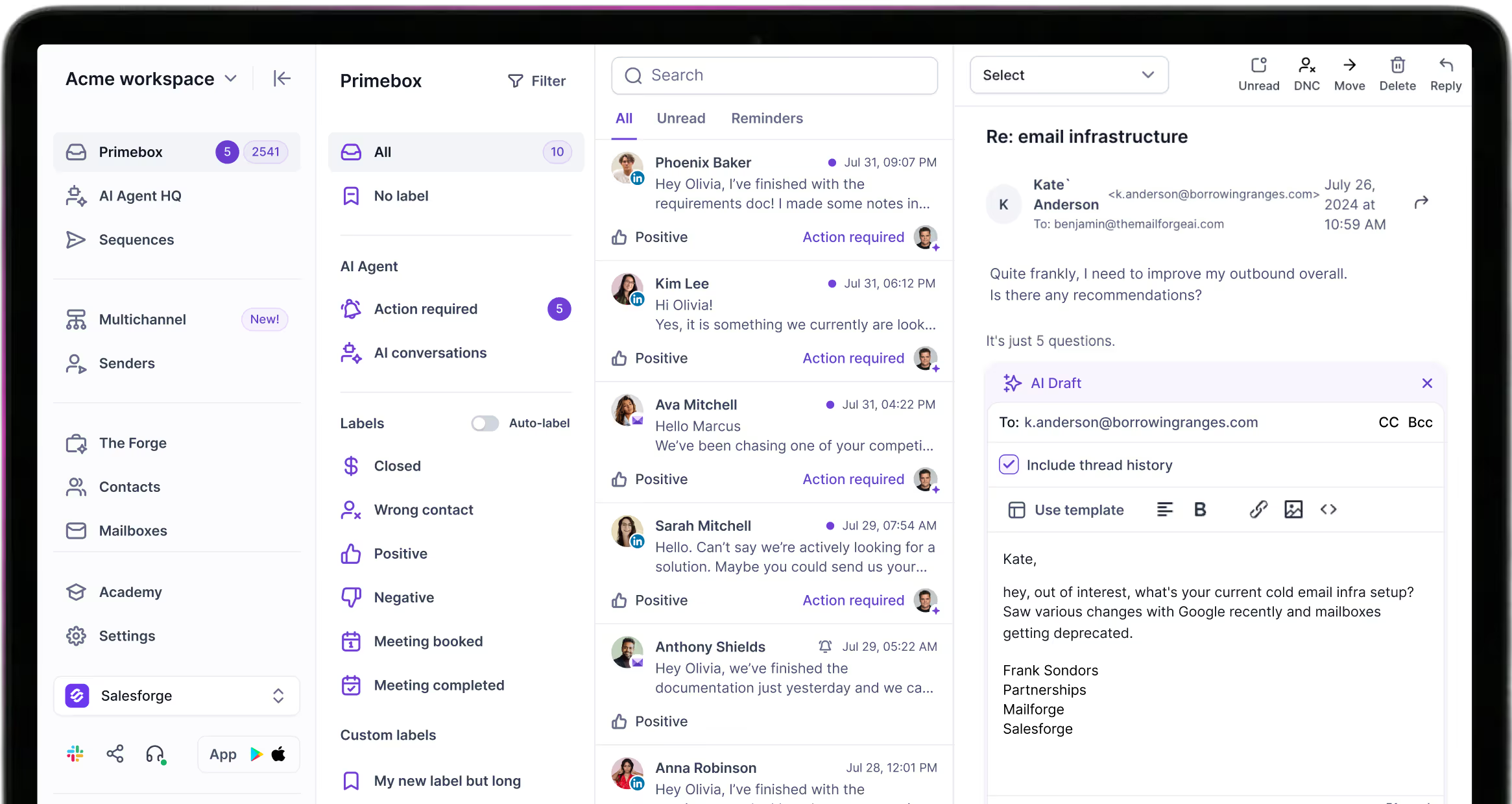
EmailBison’s platform excels at network isolation, while Salesforge, built by a former Googler and VP of sales, adds advanced AI, automation, deliverability, ease of use and even LinkedIn outreach at no additional cost. Below we explore these solutions more in depth, to give you the most complete understanding of both options.
Salesforge leverages AI to personalize cold emails and LinkedIn messages for each contact. It can craft custom icebreakers and tailor messages at scale.
EmailBison’s site includes no mention of automatic content creation: you design static sequences and A/B test variations.
Both platforms support multi-stage campaigns, but they work differently:
With Salesforge, you don’t have to copy-paste many messages or watch deadlines as closely. Salesforge’s system continuously automates and personalizes emails based on analytics.
EmailBison by comparison requires more active campaign management once the steps are set.
EmailBison provides robust A/B split testing for each step of a sequence. You can create variant subject lines or body copies and measure which performs best.
Salesforge also has A/B testing tools and on top of that uses AI and reporting to continuously optimize campaigns:
Both tools aim for high inbox placement, but their strategies differ.
Salesforge cares deeply about deliverability. It includes:
The result is premium email deliverability and low risk for LinkedIn senders.
EmailBison’s customers get:
It also integrates with tools like EmailGuard for deliverability insights.
Enter your email to get a custom plan & stack recommendation for your business
Please check your mailbox in 5 minutes
For email outreach, Salesforge even provides anti-spam features:
EmailBison, on the other hand, doesn't mention any spam prevention measures to the extent of Salesforge.
Of course, this means that Salesforge’s warmup, validations, and spam checks tend to produce very low bounce and block rates.
Building a clean contact list is critical:
EmailBison checks that an email address is valid before you send. This preemptive step reduces bounces by filtering out bad contacts up front.
Salesforge similarly validates addresses as part of campaign setup, as well as:
Running verification means far fewer bounces once you send and overall higher deliverability.
A striking difference is language support:
Salesforge explicitly allows sending sequences in many languages:
The AI can even localize messages - making Salesforge incredible useful for teams reaching international prospects.
EmailBison’s marketing does not mention multi-language at all.
Automation and data flow are essential. Salesforge has:
And many more, such as Slack or contact platforms like Clay for enriched lead data.
EmailBison also supports API and webhooks, so agencies can integrate it into their tech stack, but that's about it.
Ultimately, both platforms are scriptable, but Salesforge provides more out-of-the-box options and generally more robust integrations.
Both EmailBison and Salesforge cater to agencies, but in slightly different ways:
Salesforge gives agencies a unified platform with support and community, while EmailBison gives agencies isolated servers).
Salesforge also offers reseller/white-label options.
Salesforge is often praised for ease-of-use:
Salesforge even has built-in tutorials:
In contrast, EmailBison’s user experience is more DIY:
Another area where Salesforge shines is community and support:
EmailBison is more of a run-of-the-mill product than an experience:
If you visit the Salesforge dashboard, you’ll find links to help articles, video tutorials, and can easily “book a demo” or message support.
With EmailBison you rely on documentation or your own team’s expertise for set-up.
Salesforge provides built-in analytics for every campaign:
EmailBison’s site does not explicitly highlight analytics. Agencies might need to export to an external system to get deeper analysis.
Salesforge’s pricing is public and straightforward: Plans start at $40/month with another option at $80 per month. Both include core features like:
A 14-day free trial is available. Importantly, these are flat monthly fees - there are no per-client or contact limits advertised, making it scalable for agencies.
EmailBison does not list standard pricing online. You might pay for the software license, hosting, maintenance and even agency markup, plus any deliverability add-ons (e.g. EmailGuard).
Despite this, according to reports, EmailBison's pricing starts at $500/mo, making it a drastic increase from Salesforge.
Both EmailBison and Salesforge are strong cold outreach platforms, but they fit different needs:
If you run an agency that insists on total isolation and only cares about email outreach, EmailBison’s self-hosted model delivers that “network isolation” for each client. It also offers unlimited lists, which advanced teams may appreciate.
For users focused on results and simplicity, Salesforge has the edge. It removes technical barriers:
You don’t need a developer for technical setup. You can focus on leads and strategy, while Salesforge handles the deliverability and personalization logic.
Users find Salesforge easier to navigate and maintain:
And finish building a campaign within minutes.
Not to mention, along with email you also get LinkedIn outreach with all the plans at no hidden fees.
Ultimately, if you value built-in AI, ease of use and a full, convenient stack for every sales step, Salesforge wins hands-down. Its all-in-one platform yields fast, reliable outreach. Let Salesforge's results speak for themselves:

EmailBison and Salesforge both serve cold outreach, but Salesforge offers much more extensive and advantageous capabilities - at a much more affordable price!
EmailBison’s primary strength is its agency-friendly segregation.
Salesforge’s strengths are its AI-driven personalization, seamless sequences, extensive user support, multi-language capabilities, premium deliverability and multichannel outreach.
Yes. Salesforge supports direct integrations with CRMs like Salesforce, HubSpot, and Pipedrive, as well as Zapier and Webhooks for broader workflow automation across your sales and marketing tools. They also make a note that when any requested integration by their clients get implemented.
Absolutely. With features like inbox rotation, spam detection, and sending speed control, Salesforge is built to support high scale outreach while maintaining deliverability.
Salesforge delivers superior performance, particularly in email deliverability and personalization. It guarantees inbox delivery and utilizes AI powered personalization to craft messages tailored to each recipient, enhancing engagement rates.