Compare Tools

Outreach vs Yesware vs Salesforge: Comprehensive Sales Outreach Tool Comparison

Choosing a cold outreach platform is less about a glossy feature list and more about how reliably your outreach campaigns run, what channels the tools tackle, how safely you can scale, and whether your sales teams can unify replies and CRM data without stitching together several other tools. In this comparison we’ll look at three titans in the outreach sphere, Salesforge, Outreach and Yesware. We’ll focus on what each tool actually offers and how that translates into outreach capabilities for everyone from small teams, up to agencies and enterprises.
Let's compare:
Pricing
Starts from $48/mo/company
Request pricing
Starts from $19/mo/user
Free Trials
14-day free trial
Free plan with very limited features
Team Usage
Unlimited LinkedIn senders, mailboxes, shared workspaces and seats with Growth plan ($96/mo)
Scales with pricing
Scales with pricing
Multichannel Outreach
Outreach Channels
LinkedIn + email (phone planned in the future)
LinkedIn + email + phone
Email + LinkedIn touches (Sales Navigator subscription required)
Automated Messaging
Automated multi-channel sequences, A/B testing, multi-source AI hyper-personalization, automatic AI writing, consolidated reply inbox (Primebox)
Automated multi-channel sequences, auto/manual email steps, AI-driven workflow assistance
Automated multi-touch campaigns (can include LinkedIn Sales Navigator touches), dynamic merge fields for personalizatio, A/B testing
Analytics & Reporting
Advanced analytics (real-time, channel-specific reporting, A/B tests, campaign metrics, reply tracking)
Advanced analytics (activity-based metrics, campaign/team performance, manager/marketing insights, other custom reports)
Standard reporting dashboard (My Dashboard, Email Activity, Campaign reports, open/click/reply tracking
Email Deliverability
Free premium warm-up via Warmforge, mailbox rotation, dynamic IPs, ESP matching, placement tests
Chrome Extension
Mobile App
Whitelabel
Customer Support
24/7 email and live chat support, extensive knowledge base, large Slack community, weekly AMA sessions, video tutorials, Salesforge Academy
Email and live chat support, help center, Outreach University, webinars
Email, live chat and phone support, knowledge base, webinars, Yesware University
Integrations
Forge Stack, major CRMs, API, Zapier, webhooks, Make, Clay, Sendspark, RB2B
Major CRMs, API, Zapier, webhooks, Make, Clay, Sendspark, telephony
Salesforce, Zoom, Clari, DocSend, Teams

For a thorough understanding of what each option offers, a brief comparison table isn't enough to grasp all intricacies that come with each tool, so let's dive deeper into what makes Salesforge, Outreach and Yesware unique.

Salesforge vs Outreach vs Yesware: Sales Engagement Platform Overview & Key Features

Each vendor in this trio approaches cold outreach from a different angle. When evaluating cold outreach platforms, a clear-headed overview of each platform helps map features to business needs.

  • Outreach presents itself as an AI revenue workflow platform built for enterprise sales organizations. Its strengths manifest in sophisticated workflow management, detailed feature ratings for content and sequence steps, and deep campaign management built around sales activity and opportunity outcomes.
  • Yesware is a lightweight, Gmail/Outlook-centric tool for fast but basic email automation and email tracking. It’s a simple and cheap (though priced per-seat) option that focuses on email campaigns, quick scheduling features, email templates, and basic reporting features.

Salesforge combines every sales outreach step into a purpose-built stack for sales professionals and agencies who want a full sales cycle solution which also includes:

  • A deliverability suite with unlimited free premium warm-up (Warmforge)
  • Several proprietary infrastructure options (Mailforge, Infraforge, Primeforge)
  • Simplified and seamless lead generation and enrichment (Leadsforge)
  • And state-of-the-art campaign orchestration, multi-channel sequencing and multi-source AI hyper-personalization within the sending platform itself (Salesforge).

Pricing Plans

Salesforge provides 2 plans oriented around outreach scale and a 14-day free trial (with 2 free months granted when billed annually):

  • $48/mo/company for Pro plan (you get: 1000 active contacts in sequence, 5000 messages/mo, 100 email validation credits/mo, 100 personalization credits/mo, unlimited mailboxes, unlimited contact storage, free premium warm up via Warmforge, unlimited workspaces, connect unlimited mailboxes, a unified inbox (Primebox), mailbox rotation, dynamic IPs, live chat support and more)
  • $96/mo/company for Growth plan (you get: 10x the credits from the Pro plan, unlimited seats, A/B testing, personal onboarding, API access, 100 social action credits/month, multi-language sequences, Primebox AI reply crafting, ESP matching, access to a massive knowledge base and more)

Outreach offers per-user plans and pricing is quote-based and not published openly.

Yesware provides 3 tiered plans oriented around outreach scale + a very limited free tier (annual billing saves up to ~23%):

  • $19/seat/month for Pro plan (You get: unlimited email open/link/attachment tracking, 20 campaign recipients/month, personal activity & recipient engagement reports, email & phone support, templates & meeting scheduler, campaign building from Gmail/Outlook)
  • $45/seat/month for Premium plan (You get: everything in Pro + removes Yesware branding, unlimited campaigns, unlimited teams, shared templates & campaigns, team reporting, centralized team billing, customer success)
  • $85/seat/month for Enterprise plan (You get: everything in Premium + Salesforce Inbox sidebar, email & reply sync, calendar sync, background & bi-directional activity sync, import Salesforce list views to campaigns, SSO, trusted IP ranges, some more enterprise controls)

Multi-Channel Campaign Management

Modern sales outreach is rarely email-only. Campaigns that combine email automation with LinkedIn outreach win more attention because prospects see coordinated touches across channels.

  • Salesforge emphasizes this multi-channel approach heavily with conditional multi-channel sequences and built-in deliverability tools so scaled sending does not degrade inbox placement.

For teams that run outreach at scale, Salesforge's combination of unlimited LinkedIn senders, unlimited mailboxes, unlimited shared workspaces, and even unlimited seats reduces the need to cobble together separate tools for LinkedIn connections and proves that scale won't provide any ceiling.

  • Outreach is deliberately strong at orchestrating multi-touch, enterprise-level sequences and excels when organizations need robust native integrations and deep CRM syncing. Outreach helps large sales organizations by offering advanced sequence branching, rule-based task assignments, and analytics that tie outreach to pipeline outcomes.

Its enterprise focus means it’s engineered for companies that run complex outbound programs across many departments and can afford it.

  • Yesware’s value is its lightweight handling of email campaigns. It’s excellent for sellers who want fast email automation, scheduling tools (meeting scheduler), email templates, and straightforward email tracking.

But since Yesware is primarily email-centric, its multichannel depth - especially around LinkedIn outreach - is much more limited compared to Salesforge or Outreach.

Email Deliverability & Infrastructure

Deliverability is a “make-or-break” capability for any cold outreach program: you can have the best email templates and campaign management but if your message doesn’t reach the inbox, the campaigns fail.

  • Outreach, focused more on workflow automation and deep CRM syncs, provides best-practice guidance and tools to optimize sending behavior as part of its enterprise playbooks, which means third-party deliverability products are required for things as basic as warm-up.
  • Yesware also offers deliverability guidance and tracking and helps sales reps understand engagement through email tracking and reporting, but it also does not include any form of proprietary deliverability capabilities.

This is one area where the other options don't hold a candle to Salesforge.

  • Unlimited free warm-up via Warmforge
  • Dynamic IPs
  • Rotating mailboxes
  • Spam checkers
  • Placement tests
  • ESP matching
  • Mailbox health monitoring
  • A/B testing
  • Deliverability metrics

And more. Building sender reputation gradually while spreading volume across addresses and IPs to avoid single-mailbox throttles or sudden reputation hits is crucial for a scaling business. And that's paired with proprietary infrastructure options:

Those infrastructure features reduce the risk of landing in spam and make multi-channel outreach more reliable, especially when you have a leads database and want to integrate email at scale.

If your current sales process is seeing deliverability erosion, prioritizing a platform like Salesforge is a practical way to streamline sales processes and improve campaign ROI.

Integrations & Proprietary Stack

Scaling from a handful of reps to an enterprise sales organization changes the platform requirements. At that point, practical outreach depends on clean contact data and tight CRM integrations.

  • Outreach promotes a large integrations ecosystem, a marketplace of tech & solutions partners, and a developer portal so teams can build custom apps that extend Outreach workflows. Outreach provides deep CRM bi-directional syncs and a mature integrations experience designed for enterprise workflow management.
  • Yesware is lightweight and mailbox-centric: its integrations include some practical connectors (Gmail, Outlook, Salesforce), but the overall integration abundance isn't as robust.

Salesforge highlights a broad, practical integrations surface designed to let teams plug the platform directly into existing sales stacks. Notable Salesforge integrations include:

  • Major CRMs
  • SMTP
  • API
  • Webhooks
  • Slack
  • Zapier
  • Clay
  • Sendspark
  • RB2B
  • Whitelabel
  • The Forge Stack (Salesforge + Mailforge, Infraforge, Primeforge, Warmforge, Leadsforge)

And many more. Salesforge is also available as a Chrome extension and can be downloaded as a mobile app to provide as much convenience as possible.

If your priority is to keep the team aligned and ensure prospects are tracked consistently in your CRM, all tools cover the essentials - but Salesforge’s emphasis on consolidated data and comprehensive campaign tracking makes it slightly better when you want uniform access to replies and campaign insights across both LinkedIn and email channels.

Unified Reply Handling

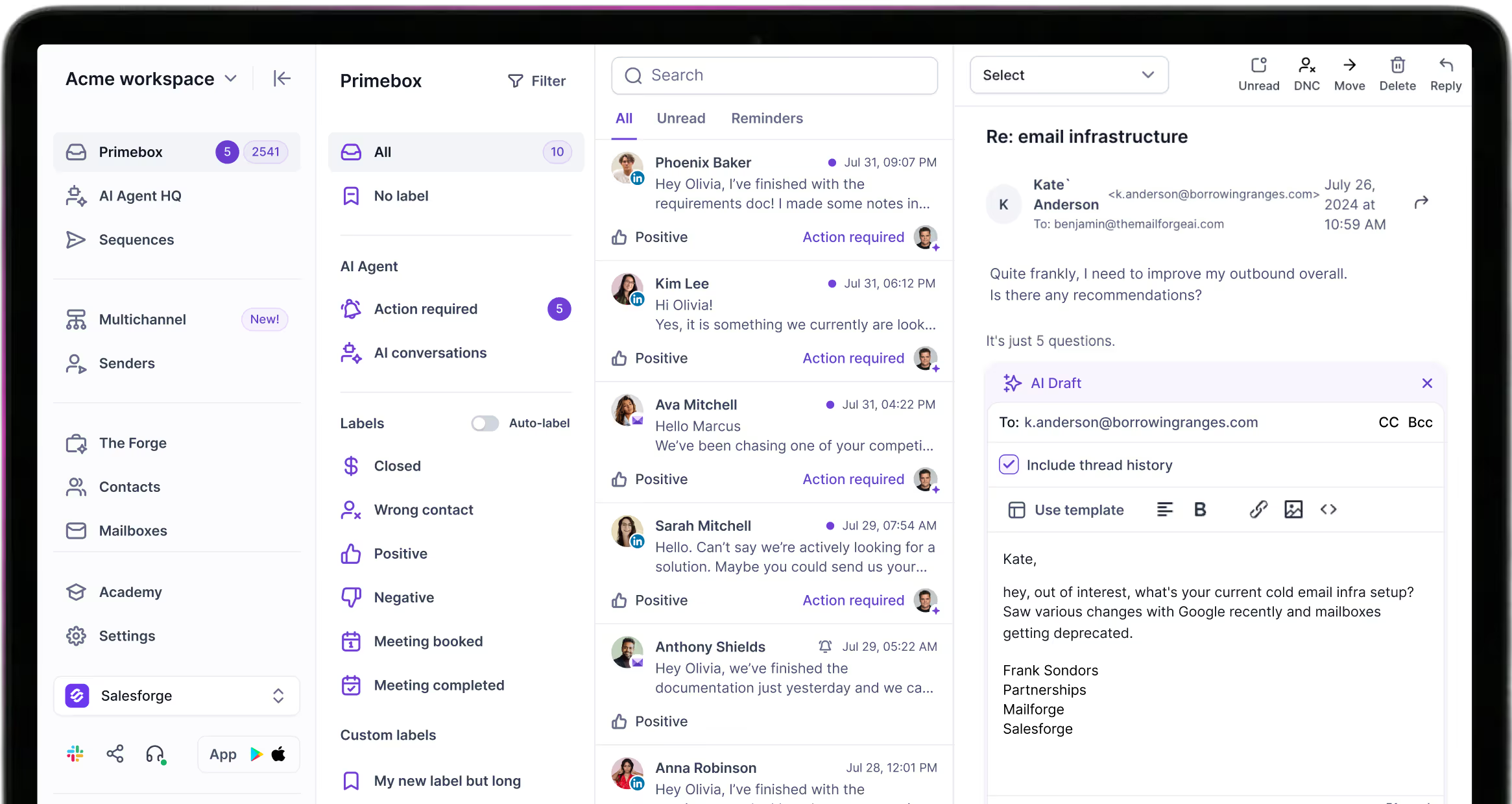
Managing replies across multiple campaigns and multiple channels is where outreach operations either scale elegantly or fall into chaos. Salesforge’s Primebox is a worthwhile highlight in this aspect - it isn’t just another “unified inbox", it’s a core part of the tool that actively ties replies back to campaigns while also layering deliverability-aware tooling and AI analysis on top.

  • Salesforge's Primebox consolidates replies from both email and LinkedIn into a single place, while capturing responses even when prospects reply from a different address, and adds AI-assisted analysis and smart tools that surface context and prioritization so teams don’t miss active leads or lose threads in a sea of mailboxes.
  • Outreach Everywhere and its inbox features let reps work from their inbox while Outreach captures email activity into the platform, automates follow-ups, and applies email sentiment classification to replies. Otherwise, they don't offer as feature-rich of a consolidated reply option as Salesforge's Primebox.
  • Yesware keeps reply handling tightly coupled to the user’s mailbox and CRM logging, but since it is primarily email-focused, it doesn't feature inbox that efficiently unifies replies across multiple channels with robust capabilities like Salesforge's Primebox.

Final Verdict: Which Is The Better Alternative For Your Sales Teams' Outreach Campaigns?

  • If your priority is a robust, enterprise-grade workflow engine, tight CRM syncs and advanced custom reporting, Outreach is the platform many organizations will look to first.

It’s great when you need a platform to manage many data points and advanced workflow management integrated deeply with popular CRMs, though these enterprise-grade features come with a hefty enterprise-grade price tag.

  • If you’re a very small business looking for a very lightweight, basic tool that gives you email automation, Yesware is a pragmatic choice.

It improves rep productivity and supports straightforward campaign management and email campaigns without steep onboarding, though the cheap price correlates with the product quality.

  • But If your work demands advanced multi-source AI hyper-personalization, state-of-the-art premium deliverability, robust integrations, and seamlessness and convenience at scale - Salesforge is the perfect choice.

For companies that prioritize multi-channel campaigns, want to run automated follow-ups at volume, need unlimited mailboxes, or just want easy access to a unified stack that handles everything from lead generation to deliverability, Salesforge is perfect for that use case.

That consolidation often translates into better inbox placement, easier campaign management, and ultimately more revenue from outbound because you can scale prospect lists, sync data efficiently, and keep all customer interactions and replies in one place.

Wanna hear more from the Forge?

Start a free trial and let's fry some 🥓bacon together!

Test out AI-powered personalization at scale for more effective outreach & more closed deals.
Thank you! Your submission has been received!
Oops! Something went wrong while submitting the form.

よくある質問

下記に知りたい内容がない場合は、チャットからお気軽にお問い合わせください

How does Salesforge stack up in an Outreach vs Yesware comparison for modern sales teams and a sales engagement platform decision?

Salesforge is an all-in-one stack (lead gen → deliverability → sequencing) while Outreach targets enterprise workflow and Yesware is a lightweight tool for email. For teams wanting multi-channel orchestration, built-in deliverability, and more than strong features without stitching two tools together, Salesforge’s two pricing plans (Pro/Growth) aim to be a reasonable price for high scale. Many users pick Salesforge to avoid separate platform complexity and get better engagement across channels.

Can Salesforge run multichannel campaigns and replace a separate platform for outreach efforts?

Yes - Salesforge emphasizes conditional multichannel campaigns (email + LinkedIn) and centralizes replies via Primebox. While phone calls aren’t the platform’s primary outbound channel, Salesforge supports call workflows through CRM/telephony integrations, letting you coordinate calls with email and LinkedIn touches for better engagement without cobbling together separate systems.

Does Salesforge offer task management, team collaboration, and handle multiple data points the way Outreach integrates with CRMs?

Salesforge includes shared workspaces, mailbox rotation, and unified reply handling to support team collaboration and basic task management. It ingests multiple data points (CRM fields, API, webhooks) and offers native CRM/Slack/Zapier connectors. While Outreach integrates deeply for complex enterprise workflows, Salesforge focuses on consolidating data and actions so sales teams don’t need an extra platform to coordinate outreach efforts.

What do users report about Salesforge for email tracking, deliverability and prospect engagement versus Yesware’s lightweight approach?

Many users report that Salesforge’s deliverability stack (warm-up, dynamic IPs, mailbox rotation) produces higher inbox placement than relying on email tracking alone. Yesware is praised as a lightweight tool with solid email tracking and quick adoption, but Salesforge users often see better engagement when combining advanced deliverability, AI personalization, and unified reply handling across channels.

Is the learning curve for Salesforge worth it compared to using two tools (e.g., Outreach + a deliverability product), and do the pricing plans justify the trade-offs?

There’s an upfront learning curve - Salesforge’s depth means initial setup takes work - but it replaces the overhead of managing a CRM-integrator + separate deliverability tool. For teams prioritizing strong features across the stack and reducing vendor sprawl, Salesforge’s two pricing plans often prove a reasonable price versus paying per-seat for multiple platforms. Many users find consolidation saves time and improves campaign ROI.