Compare Tools

Apollo vs Salesloft vs Salesforge: Comprehensive Cold Outreach Tool Comparison

Choosing a cold outreach platform is less about a glossy feature list and more about how reliably your outreach campaigns run, what channels the tools tackle, how safely you can scale, and whether your sales teams can unify replies and CRM data without stitching together several other tools. In this comparison we’ll look at three titans in the outreach sphere, Salesforge, Apollo and Salesloft. We’ll focus on what each tool actually offers and how that translates into outreach capabilities for everyone from small teams, up to agencies and enterprises.
Let's compare:
Pricing
Starts from $48/mo/company
Starts from $59/mo/user
Contact for pricing
Free Trials
14-day free trial
100 credits/mo/user
Team Usage
Unlimited LinkedIn senders, mailboxes, shared workspaces and seats with Growth plan ($96/mo)
Unlimited mailboxes, everything else scales with pricing
Scales with pricing
Multichannel Outreach
Outreach Channels
LinkedIn + email (phone planned in the future)
LinkedIn + email + phone
Automated Messaging
Automated multi-channel sequences, A/B testing, multi-source AI hyper-personalization, automatic AI writing, consolidated reply inbox (Primebox)
Automated multi-channel sequences, AI-assisted sequence generation, standard AI personalization
Multi-channel cadences, A/B tests, AI agents / generative email assistant to draft & personalize messages
Analytics & Reporting
Advanced analytics (real-time, channel-specific reporting, A/B tests, campaign metrics, reply tracking)
Standard analytics with configurable dashboards (open/click/reply tracking, campaign & team metrics, goal tracking, A/B tests)
Centralized Analytics (team cadence Analytics, platform-level reports, channel metrics)
Email Deliverability
Free premium warm-up via Warmforge, mailbox rotation, dynamic IPs, ESP matching, placement tests
Warm-up, mailbox rotation, custom tracking-domain guidance
Deliverability best-practice guidance + a partner ecosystem / marketplace for further third-party deliverability tooling
Chrome Extension
Mobile App
Whitelabel
Customer Support
24/7 email and live chat support, extensive knowledge base, large Slack community, weekly AMA sessions, video tutorials, Salesforge Academy
Email, live chat and phone support, knowledge base, Apollo Academy
Email, phone and live chat support, knowledge base, Salesloft Academy, occasional webinars
Integrations
Forge Stack, major CRMs, API, Zapier, webhooks, Make, Clay, Sendspark, RB2B
Major CRMs, API, Zapier, webhooks, Make, Clay, Sendspark, RB2B

For a thorough understanding of what each option offers, a brief comparison table isn't enough to grasp all intricacies that come with each tool, so let's dive deeper into what makes Salesforge, Apollo and Salesloft unique.

Salesforge vs Apollo vs Salesloft: Outreach Automation Tool Overview & Advanced Features

When evaluating cold outreach platforms, a clear-headed overview of each platform helps map features to business needs:

  • Apollo is framed as a combined sales intelligence and sales engagement platform. Its strengths are primarily its very large contact database, data enrichment capabilities, and integrated sequences (though Leadsforge offers similar capabilities for Salesforge as well)
  • Salesloft pitches itself as a revenue orchestration and cadence automation platform for complex sales processes and enterprise sales teams. Its strengths are deep workflow automation and extensive integrations that support full-cycle pipeline management, though enterprise-targeting means prices become heavily inflated as well.
  • Salesforge positions itself as the all-in-one cold outreach solution that combines email + LinkedIn multi-channel outreach, advanced multi-source hyper-personalization, premium deliverability protection, state-of-the-art reply consolidation (via the Primebox), responsive customer support, and even robust campaign analytics - all framed for teams that want straightforward, high-quality and high-volume outbound without a heavy ops layer.

Each platform speaks to slightly different priorities, but let's see how the tools differentiate from each other in specific fields.

Pricing Structure

Salesforge provides 2 plans oriented around outreach scale and a 14-day free trial (with 2 free months granted when billed annually):

  • $48/mo/company for Pro plan (you get: 1000 active contacts in sequence, 5000 messages/mo, 100 email validation credits/mo, 100 personalization credits/mo, unlimited mailboxes, unlimited contact storage, free premium warm up via Warmforge, unlimited workspaces, connect unlimited mailboxes, a unified inbox (Primebox), mailbox rotation, dynamic IPs, live chat support and more)
  • $96/mo/company for Growth plan (you get: 10x the credits from the Pro plan, unlimited seats, A/B testing, personal onboarding, API access, 100 social action credits/month, multi-language sequences, Primebox AI reply crafting, ESP matching, access to a massive knowledge base and more)

Apollo provides 4 plans oriented around outreach scale + a Free plan with limited credits (discounted annual billing):

  • $0/mo/user for Free plan (you get: basic contact access and search, Chrome & Gmail extensions, limited monthly credits and export ability, up to a couple of sequences for outreach, basic filters, email campaigns (Gmail only for non-paying accounts), limited API/export access and more)
  • $59/mo/user for Basic plan (you get: significantly more credits and export allowance, advanced filters and intent topics, sequence automation, meeting scheduler, CRM & enrichment integrations, more API/export capacity, larger daily send limits and more)
  • $99/mo/user for Professional plan (you get: higher credit allocations, unlimited/advanced sequences and A/B testing, dialer & call features (US dialer), AI research/composer tools, advanced reporting & dashboards, increased mailboxes/send limits and more)
  • $149/mo/user for Organization plan (you get: the highest credit limits (team/enterprise scale), advanced admin controls (SSO, permissions), API access and integrations for orgs, custom reporting, priority support and account-level controls)

Salesloft requires contacting sales for pricing information, though it's likely their pricing doesn't go lower than triple digits.

Multi-Channel Sequences

Successful sales operations rely on automated email sequences with deliberate LinkedIn touches that scale without losing personalization. All three platforms offer sequence builders and multi-channel capabilities, but they approach them differently.

  • Apollo’s Engage product emphasizes sequences that include email, LinkedIn, and even a dialer + the ability to trigger follow-ups based on prospect behavior. This makes Apollo a nice option when lead generation and data-driven outreach are tightly coupled.
  • Salesloft’s cadence automation is built for larger teams running complex sales workflows. It supports multiple channels (including email, phone, SMS, and LinkedIn InMail), and it layers conversation intelligence and cross-channel reporting to help sales reps prioritize the right sales activities.

Salesforge takes multi-channel sequences a step further.

  • It highlights multi-channel campaigns that combine email and LinkedIn with premium deliverability and sender reputation features for high-volume outreach.
  • Salesforge supports unlimited mailboxes, unlimited LinkedIn senders, unlimited shared workspaces, and even unlimited seats - guaranteeing that reaching a scaling ceiling won't be an issue.
  • Additionally, Salesforge supports multi-source AI hyper-personalization when automatically drafting messages for your team.

This is crucial for sales strategies with consistently high-quality outbound results and seamless meeting scheduling across teams.

If your priority is straightforward, cost-effective sequence creation and keeping inboxes healthy and messages reliable under high throughput, Salesforge’s simplicity and multi-mailbox approach can significantly enhance day-to-day sales efforts.

Unified Reply Handling

A practical sales engagement platform needs to do more than send sequences - it must ensure replies are captured, routed, and actioned so pipeline momentum doesn’t evaporate the moment a prospect replies from an alternate address or channel.

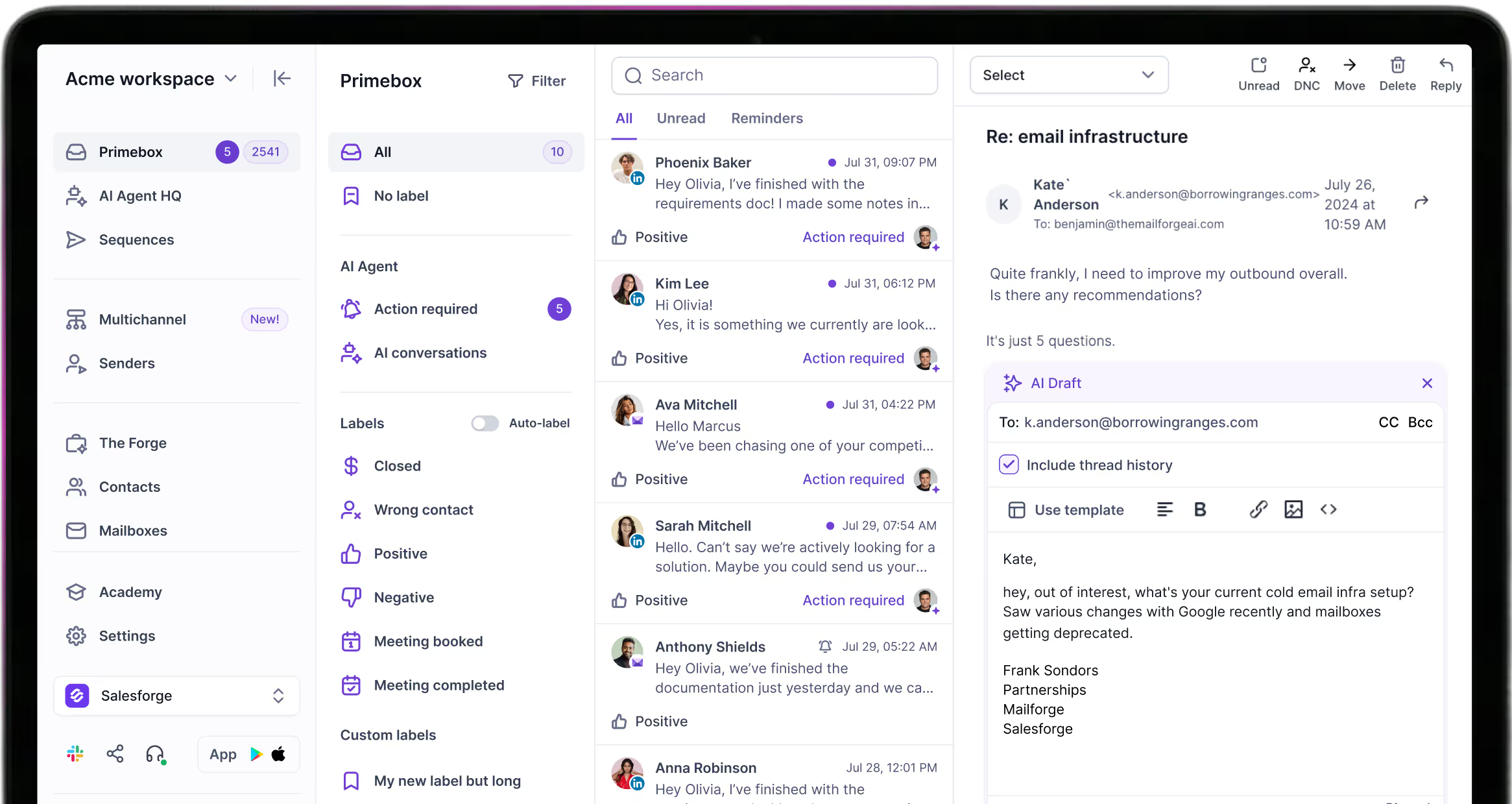
Salesforge’s Primebox is worth highlighting in this aspect - it isn’t just another “unified inbox", it’s a core part of the tool that actively ties replies back to campaigns while also layering deliverability-aware tooling and AI analysis on top.

  • Salesforge's Primebox consolidates replies from both email and LinkedIn into a single place, while capturing responses even when prospects reply from a different address, and adds AI-assisted analysis and smart tools that surface context and prioritization so teams don’t miss active leads or lose threads in a sea of mailboxes.

By contrast, the “standard” sequence behavior you see in Apollo and Salesloft doesn't offer the advanced consolidated reply capabilities across channels like Salesforge does.

Email Deliverability & Infrastructure

Deliverability is the single biggest practical constraint on any cold email outreach effort: you can have the best subject lines and highly personalized sequences, but if mail goes to the spam folder, outbound sales and response rates collapse.

  • Apollo provides deliverability guidance and has some basic features for deliverability, such as warm-up and mailbox rotation. Otherwise, its public face is more about using data and engagement signals to scale campaigns. Deliverability control is still present but not the central focus.
  • Salesloft includes deliverability-adjacent features (like inbox tools and coaching) and offers robust cadence controls, but it relies on third party tools for warm-up and other deliverability functionality. It’s often positioned as the enterprise orchestration layer where conversation intelligence and cross-channel reporting are the headline attributes.

Ultimately, this is one area where the other options don't hold a candle to Salesforge.

  • Unlimited free warm-up via Warmforge
  • Dynamic IPs
  • Rotating mailboxes
  • Spam checkers
  • Placement tests
  • ESP matching
  • Mailbox health monitoring
  • A/B testing
  • Deliverability metrics

And more. Building sender reputation gradually while spreading volume across addresses and IPs to avoid single-mailbox throttles or sudden reputation hits is crucial for a scaling business. And that's paired with proprietary infrastructure options:

Those infrastructure features reduce the risk of landing in spam and make multi-channel outreach more reliable, especially when you have a leads database and want to integrate email at scale.

If your current sales process is seeing deliverability erosion, prioritizing a platform like Salesforge is a practical way to streamline sales processes and improve campaign ROI.

Proprietary Integrations & Proprietary Stack

Scaling from a handful of reps to an enterprise sales organization changes the platform requirements. At that point, practical outreach depends on clean contact data and tight CRM integrations.

  • Salesloft offers an extensive marketplace and partner ecosystem designed to let enterprise teams assemble a comprehensive suite of external tools - everything from conversation intelligence to intent providers - into a revenue orchestration system.

That marketplace model is great for massive enterprise teams that need predictive analytics, deep CRM integration, and pipeline management across many systems, but it assumes you will leverage other specialist platforms as part of a larger proprietary or semi-proprietary tech stack.

  • Apollo’s product strategy positions it as both an engagement platform and a sizable contact/data provider, with various integrations (including major CRMs, API, webhooks, Zapier, etc.) + a Chrome extension that let reps capture contact data and push it to existing CRM systems, and a mobile app too.

Salesforge highlights a broad, practical integrations surface designed to let teams plug the platform directly into existing sales stacks. Notable Salesforge integrations include:

  • Major CRMs
  • SMTP
  • API
  • Webhooks
  • Slack
  • Zapier
  • Clay
  • Sendspark
  • RB2B
  • Whitelabel
  • The Forge Stack (Salesforge + Mailforge, Infraforge, Primeforge, Warmforge, Leadsforge)

And many more. Salesforge is also available as a Chrome extension and can be downloaded as a mobile app to guarantee convenience.

If your priority is to keep the team aligned and ensure prospects are tracked consistently in your CRM, all tools cover the essentials - but Salesforge’s emphasis on consolidated data and comprehensive campaign tracking makes it slightly better when you want uniform access to replies and campaign insights across both LinkedIn and email channels.

Final Verdict: Choosing The Right Sales Engagement Platform For Your Needs

If you map needs to product strengths:

  • Choose Salesloft when you’re a massive enterprise team needing advanced revenue orchestration, deep CRM integration, and analytics to support complex sales processes and long deal cycles (as long as you're willing to pay the price).
  • Choose Apollo when lead generation, contact data, and integrated enrichment are critical to your sales strategy (although consider Leadsforge as another alternative for those exact capabilities)
  • And choose Salesforge when the priority is streamlined, cost-effective outbound that protects inboxes and powers high-volume prospecting with simple multi-mailbox management, email validation, and actionable campaign analytics.

Salesforge is a practical fit for teams of all sizes that want the right sales engagement platform without a heavy ops burden or a steep learning curve.

For teams looking for a user-friendly interface, efficient workflow automation, and deliverability-first outreach that integrates with existing CRM systems and external tools, Salesforge represents a balanced choice that significantly enhances outbound sales efforts while minimizing operational complexity and manual work.

Wanna hear more from the Forge?

Start a free trial and let's fry some 🥓bacon together!

Test out AI-powered personalization at scale for more effective outreach & more closed deals.
Thank you! Your submission has been received!
Oops! Something went wrong while submitting the form.

よくある質問

下記に知りたい内容がない場合は、チャットからお気軽にお問い合わせください

In an Apollo vs Salesloft comparison, where does Salesforge sit as a sales engagement platform?

Salesforge is an all-in-one solution focused on deliverability-first multichannel outreach. It combines user-friendly interface and campaign analytics with email + LinkedIn automation, hyper-personalization, and Primebox reply consolidation. Compared to Apollo vs Salesloft, it trades neither heavy ops (Salesloft) nor pure data breadth (Apollo) - instead it gives smaller teams and sales professionals a practical, lower-friction platform without the higher price point.

Can Salesforge replace other sales tools and offer seamless integration with my existing tech stack?

Yes. Salesforge supports major CRMs, SMTP, API, webhooks, Slack, Zapier, a Chrome extension and mobile app. That seamless integration helps sales leaders and marketing teams consolidate customer data, reduce tool sprawl, and keep prospect and campaign history synced - letting teams retire point solutions and centralize outreach and tracking.

How does Salesforge power outbound prospecting, LinkedIn automation, and engagement features to drive revenue growth?

Salesforge runs multichannel outreach (email + LinkedIn), unlimited mailboxes and LinkedIn senders, AI hyper-personalization, lead data enrichment, and campaign analytics. Those engagement features plus follow-ups and placement safeguards improve inbox placement and engagement metrics, helping sales reps and marketing teams convert prospecting efforts into measurable revenue growth.

Is Salesforge suitable for sales leaders who need deep analytics, workflow management, and data-driven decisions tied to sales goals?

Absolutely. Salesforge offers detailed analytics, A/B testing, deliverability & placement metrics, Primebox context and API access. These workflow capabilities and engagement metrics let sales leaders track sales performance, iterate sequences, and align outreach to sales objectives - providing the deep analytics needed for data-driven decisions without added complexity.

What are Salesforge pricing plans, does it offer transparent pricing or custom pricing, and how does that compare to Salesloft vs Apollo?

Salesforge lists two transparent plans: Pro ($48/mo/company) and Growth ($96/mo/company), 14-day trial, plus two free months with annual billing. Growth adds onboarding, API, A/B testing and unlimited seats. Outreach/Salesloft often require quotes and hit a higher price point; Apollo uses per-user tiers. No additional setup fees are mentioned in the text above.