
Personalized Outbound Strategy
Get The Right Outbound Strategy In Minutes
Enter your email to get a custom plan & stack recommendation for your business
It's being carefully crafted by AI
Please check your mailbox in 5 minutes

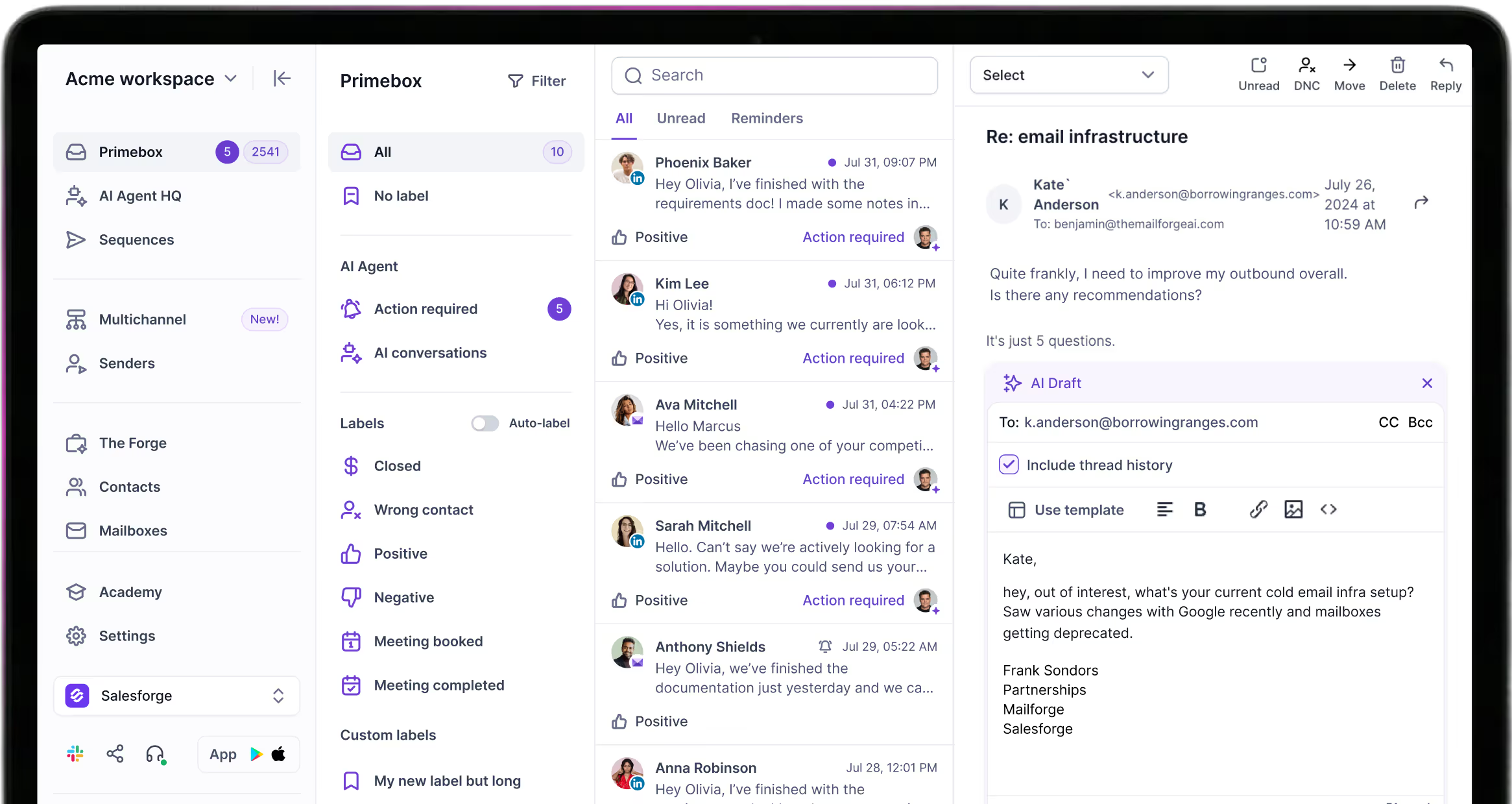
For a thorough understanding of what each option offers, a simplified comparison table isn't enough to grasp all intricacies that come with each tool, so let's dive deeper into what makes Ken AI and Salesforge's Agent Frank unique.
When deciding between Ken AI and Agent Frank, start by understanding the product model. Ken AI presents itself as a technology-first outbound agency. They combine:
To build and run precision email campaigns for clients. Ken searches the web for your ideal clients, pulls data from LinkedIn, Google, websites and 20 other platforms, and delivers human-level personalization in each message.
Ken also sells results with statistics (open/click/reply rates) and promises to protect your main company domain by sending from independent domains and dedicated servers.
Agent Frank, built by a former Googler and VP of sales, is a turnkey solution within a tightly integrated suite (The Forge Stack) - designed to run on auto-pilot and reduce all manual tasks that typically burden SDRs.
Agent Frank reads like a plug-in replacement for an entire SDR hire, while Ken reads more like outsourcing your outreach to a specialist team that brings its own data and writers.
Or just let Agent Frank's results speak for themselves!

Agent Frank provides flexible pricing oriented around outreach scale. Pricing is charged by Active Contacts (the number of prospects the Agent is processing at any given time), and annual billing includes 2 months free. There is no free trial and demos are required before purchase.
Note that infrastructure to process those contacts via email is not included in this base price. The Salesforge Stack offers multiple infrastructure options based on your budget/needs, so you don't need to stitch third-party products to make it work. The best options for Agent Frank include:
The Forge team will help set up the mailboxes and, additionally, the Mailforge (shared IP) and Primeforge (Gmail and Outlook) email infrastructure options are also available. Additionally, teams can connect their own mailboxes from other providers if desired.
Ken AI offers done-for-you, subscription pricing oriented around monthly campaign volume and outcome-based performance fees.
Speed to impact is crucial for growth and marketing teams.
That model is explicitly designed so the agent can be customized (tone, languages, work hours, even availability) and have a safe, managed warm-up period before full sending starts.
The combination of human support + an in-platform agent reduces the operational friction new hires or co-founders would otherwise face as they add outreach to their stack.
Ken’s onboarding is implicitly heavier on Ken’s team doing the initial lift, while Agent Frank’s onboarding model gives buyers a hybrid choice: human setup + a persistent AI SDR that lives in your Salesforge account and can be freely adjusted by your team.
Both vendors highlight the same business problem - poor generic outreach - and both emphasize personalization and brand voice, but they operationalize them differently.
That model is effective when your priority is bespoke scripts and the knowledge that copywriting was written and approved by individuals.
Agent Frank’s approach is more automated multi-source hyper-personalization: combine uploaded knowledge bases and in-platform personalization logic to create high-volume, consistent outreach that still references prospect specifics.
Where Agent Frank stands out for many growth teams is the balance between scale and brand control. You get a persistent AI SDR that uses your brand’s knowledge base and the prospect’s public information to keep messages relevant, while Ken’s approach tends to be higher-touch per message because of manual copywriter involvement.
For companies that need to scale dozens of campaigns across many markets and want to preserve brand voice while minimizing the human-hours per message, Agent Frank’s in-system hyper-personalization is a practical advantage.
Enter your email to get a custom plan & stack recommendation for your business
Please check your mailbox in 5 minutes
Understanding which channels each solution covers matters for a sales organization that expects omnichannel touches.
Deliverability and infrastructure are where differences become operationally decisive. Deliverability is the linchpin of cold outreach success - a brilliant sequence is worthless if emails land in spam - and this is one area where Agent Frank intentionally differentiates itself.
And more. Building sender reputation gradually while spreading volume across addresses and IPs to avoid single-mailbox throttles or sudden reputation hits is crucial for a scaling business. And that's paired with proprietary infrastructure options:
Those infrastructure features reduce the risk of landing in spam and make multi-channel outreach more reliable, especially when you have a leads database and want to integrate email at scale.
Ken AI advertises its own dedicated IP email infrastructure with independent domain names to protect your primary domain and a spam checker. They even claim better deliverability than Gmail/Outlook. Otherwise, Ken AI's email deliverability capabilities are fairly lackluster.
For sales teams or lead generation agencies focused on large scale operations and high-volume cold outreach, the difference matters. Agent Frank’s model minimizes the operational burden of maintaining email metrics, domain health, and warm-up cycles so teams can scale sends across many mailboxes with less risk.
Their approach is to combine LinkedIn Sales Navigator with AI cross-referencing the web to validate and rank prospects, and then run human-plus-AI qualification to ensure fit.
Moreover, Agent Frank uses numerous data providers and waterfall enrichment to ensure high quality leads that fit a company's ICP as closely as possible.
When picking a tool to drive pipeline at the company level, support and learning resources aren’t just comforts. They determine how fast new hires ramp, how well revenue teams capture intent signals, and whether your sales organization can turn intent data into meetings without months of engineering work.
Overall, Ken AI follows the basic path of balancing human support with documentation and learning resources to minimize friction and accelerate value.
Salesforge's approach further reduces the manual tasks sales teams often struggle with - no separate deliverability vendor, fewer manual data entry steps, and a partner focused on ironing out initial list hygiene and infrastructure.
Besides that, Agent Frank customers also get:
For growing sales teams and lead generation agencies that prefer to shift heavy operational overhead away from internal staff, Agent Frank’s model is a strong fit.
They offload the manual tasks that consume SDR time and let reps focus on higher-value activities like closing deals and handling qualified leads.
Both Ken AI and Agent Frank solve the same core problem - turning prospects into warm meetings through personalized outreach - but they map to different buyer priorities.
Choose Ken AI if you want a managed, copywriter-driven outbound program where Ken’s team handles part of the discovery, script creation, manual personalization and sends from a vendor-managed infrastructure.
Choose Agent Frank if you want a dedicated AI SDR that lives inside a sales execution platform and:
If you value speed to scale and an efficient agent that can act continuously inside your tech stack while your reps focus on closing, Agent Frank is the perfect fit.
Agent Frank is an AI SDR that runs precision outreach across email and LinkedIn - a single agent layer that engages prospects in multiple channels. It uses multi-source personalization and reusable templates so your team can launch campaigns that target the ideal customer, enhance relevance, and convert prospects into meetings. Rather than stitching tools, Agent Frank operates as an execution layer that scales outreach for clients and helps your market-facing reps focus on closing.
Agent Frank sources and enriches contact info from many providers, continuous prospecting, and targeted searches (including Google-derived signals). It verifies emails, ranks prospects against your ICP, and runs qualification logic so the agent only passes high-fit people to sales. You can upload lists or let the agent source clients automatically; the software fine-tunes who to engage so your reps see fewer low-quality leads.
Yes - you can fine tune tone, goals, and message layers, upload custom templates, and enhance performance by iterating subject lines or AI variables. Agent Frank supports integrations and APIs so your engineers or founder can connect it to CRMs, enrichment tools, or reporting dashboards. That customizability helps you launch tailored campaigns, measure template performance, and adjust budgets or who you pay for outreach.
Agent Frank couples AI-generated personalization with deliverability infrastructure (warm-up, rotating mailboxes, dynamic IPs) to maximize inbox placement and avoid spam folders. The combination of prospect-aware messages, smart follow-ups, and mailbox hygiene generally boosts positive reply rates and the number of prospects who convert to meetings - reducing the need for extra hiring while improving sales performance across the market you target.
Founders and growth teams typically see Agent Frank reduce hiring needs and accelerate pipeline: fewer SDR hires, faster launch cycles, and more predictable conversions. Pricing is usage-based (Active Contacts) and designed so clients pay for scale rather than per-send. By consolidating prospecting, outreach, and deliverability, Agent Frank grounds your GTM efforts, improves performance metrics, and helps you measure which campaigns and content actually convert into revenue.