For years, the default go-to-market motion was built on volume. Pull a list of everyone who matches a rough ICP, blast them with emails, hope enough respond. It worked until buyers became more educated than the sellers themselves.
The problem now is not that outreach stopped working. The problem is targeting everyone in your market with the same message when they have not indicated a need for your product. That lack of context turns you into a spammer and damages your brand in the process.
So moving from "who fits our ICP" to "who fits our ICP and something just happened that makes them relevant right now" is the shift that separates the teams booking meetings from the teams getting ignored.
In this post, I break down exactly how signal-based outbound works in practice: two production-ready workflows, the tools behind them, the mistakes to avoid, and why acting on signals within two hours is the benchmark that matters.
The old playbook was simple. Find everyone who matches a rough ICP, put them in a sequence, and send. It worked until buyers became more educated than the sellers reaching out to them.
So moving from "who fits our ICP" to "who fits our ICP and something just happened that makes them relevant right now" is a much-needed shift in how modern GTM practitioners think.
The data backs this up. Signal-based outbound drives 4x more deals and 80% higher reply rates compared to standard volume-based outreach.
When you reach someone at the moment a signal fires, like a new hire, your message lands in a context where it is actually relevant rather than just interrupting. You are arriving exactly when the problem you solve is top of mind. There is also a timing dimension most teams underestimate.
Santosh Sharan, the previous head of GTM at ZoomInfo, shared with me once that if your signals are not acted on within a two-hour window, relevancy degrades and so does your probability of booking a call.
This is why signal-based prospecting exists. Not as a tactic, but as a structural, repeatable advantage, which is exactly what I cover in the rest of this article.
Before getting into what good looks like, it is worth showing what bad looks like because it is everywhere.
The example below is one of the most common patterns in B2B outreach today. A single sender, firing off "Congrats on your new role" and "Congrats on your work anniversary" messages over and over, to the same person, spanning nearly two years.
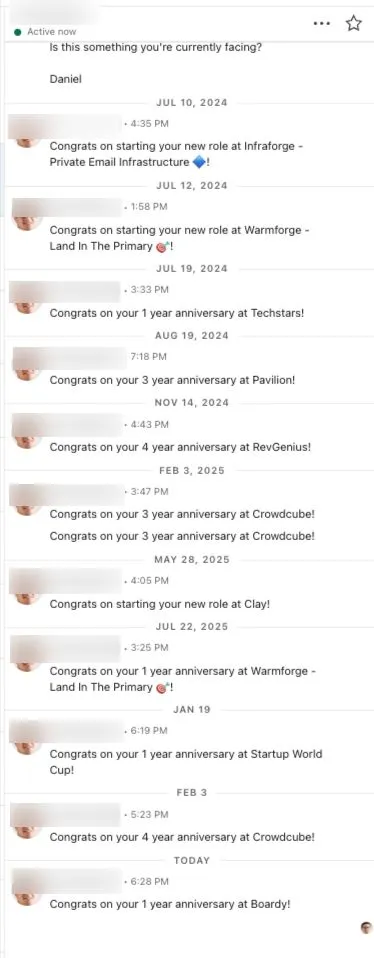
Technically every single message is signal-triggered, but there is zero context, zero relevance, and zero value added. It is just a bot congratulating someone on the passage of time until they ignore you, mute you, or block you.
Instead of asking "what happened?", you need to pivot your mindset towards: "What does this mean for them right now, and how does that connect to what I do?"
Because just like that, the sender in that example burned every bit of credibility across two years of meaningless touchpoints. When they finally have something worth saying, there is nothing left to say it with.
Beyond this specific mistake, three broader failure modes kill signal-based GTM before it starts:
Every signal you pull hits the wrong accounts, burns credits, and generates outreach that goes nowhere. Define your ICP and custom qualification or signal before you build anything.
Each new addition is a potential point of failure so validation in isolation is a must. Only integrate once it is proven.
Map your current process before you automate it. If you implement an agentic system without documented architecture, nobody on the team can own, trust, or maintain it.
This is the evergreen signal-based outbound motion which, if you set it up once, will help you find new business continuously.
The starting point is Signalbase's MCP, queried directly inside Claude Code.
The use case for this demo: a GTM/SEO product targeting marketing teams.
The custom signal: companies that have recently hired or promoted a marketing leader or content/SEO-related person, as they almost immediately evaluate what to replace or scale in the current infrastructure. That is the buying window.
When trying to narrow down your prospecting further, try looking at website traffic or LLM SEO visibility as an additional qualification layer. If you can mention it within the outreach copy your chances of standing out increase massively.
As a next step, Claude Code will pull companies with recent funding combined with a job change or hiring activity for marketing and SEO roles. From 4,000+ results, the list tiers automatically:
Claude Code surfaces the top five priority accounts and exports the full qualified list to CSV.
Signalbase advantage: every signal comes with a complete company profile attached including people data so there is no separate enrichment call just to know who works there. One API call = full company intelligence.
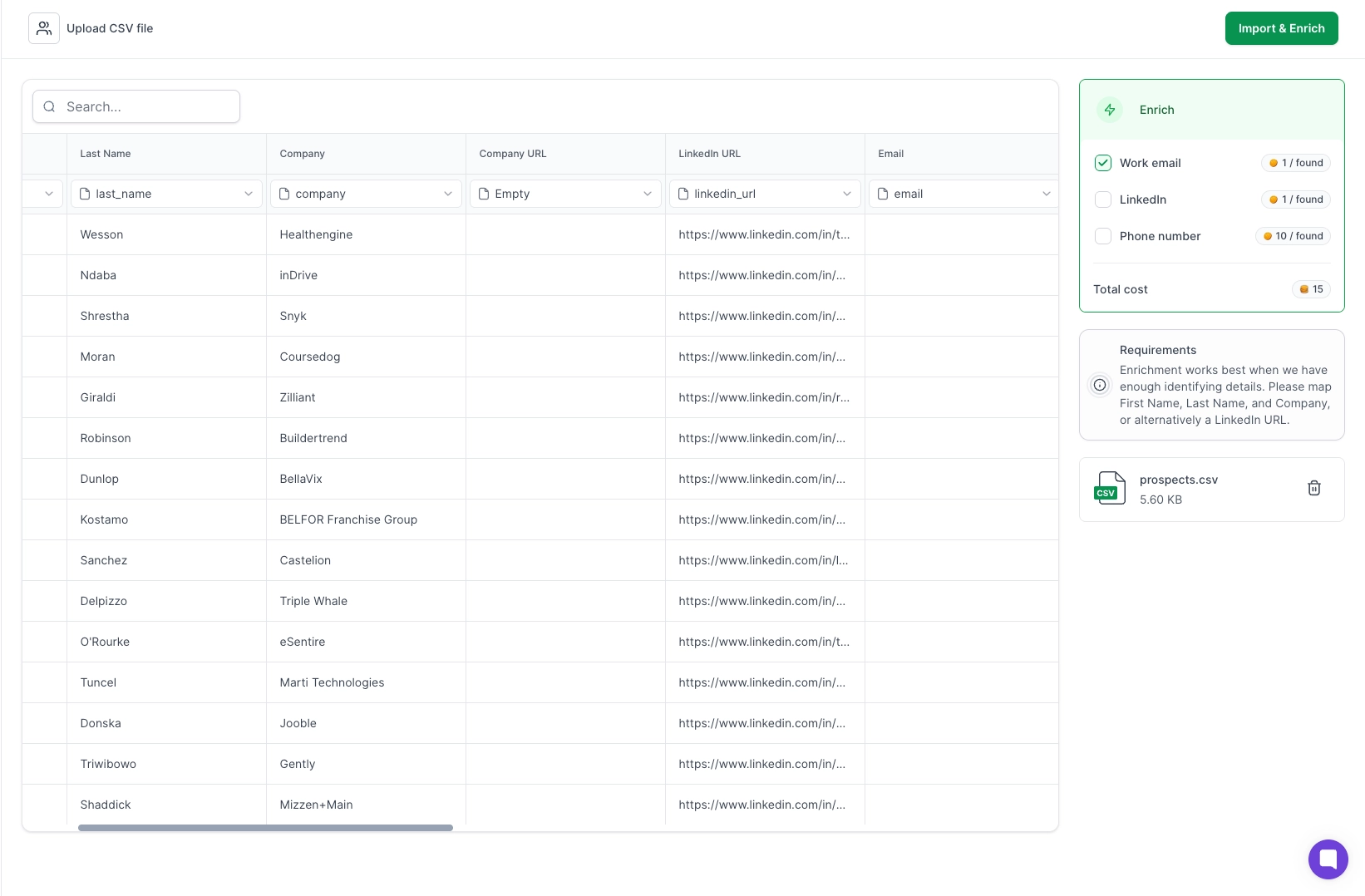
With the qualified list in hand, Leadsforge handles waterfall enrichment for contact emails, pulling from multiple providers so hit rate stays high regardless of any single source's gaps.
Output: a clean, enriched lead list with company context from Signalbase and verified contact emails from the Salesforge ecosystem.
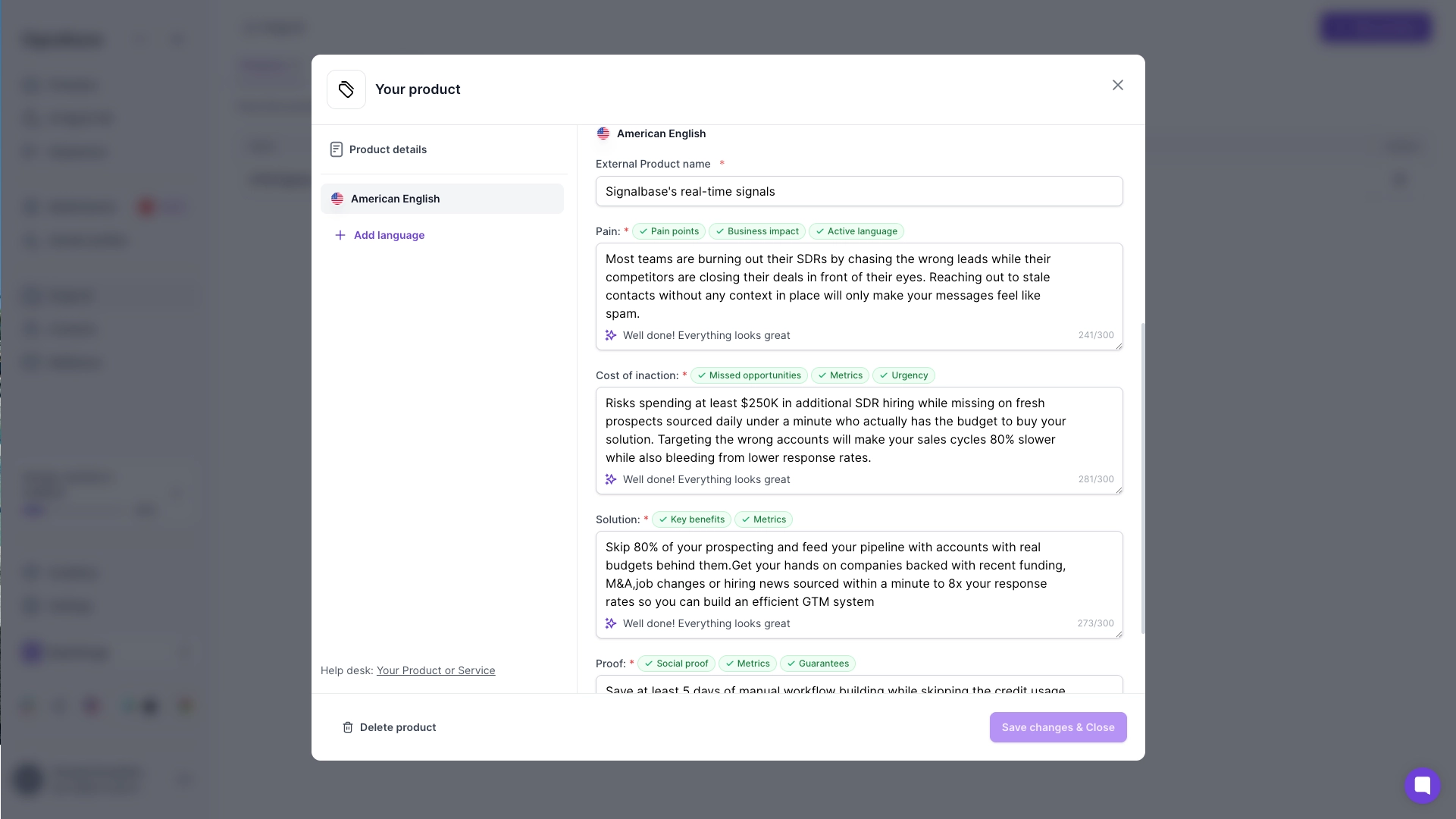
Once you create your account, you can also create your "products" which will help Salesforge to analyze your website and generate dedicated sales copy that becomes the foundation of your outbound strategy.
From there, create a multichannel combined outbound campaign covering both email and LinkedIn in a single coordinated sequence. Salesforge's AI personalization applies the account and contact context at the message level, so each contact receives outreach that speaks to their specific situation at the moment it is most relevant.
Signalbase MCP → signal detected + full company profile attached
↓
Claude Code → filter and tier accounts by signal combination
↓
Export qualified list to CSV
↓
Leadsforge → waterfall enrichment for contact emails
↓
Salesforge product builder → analyzes your website to sharpen copy
↓
Salesforge → multichannel campaign launched (email + LinkedIn)
↓
AI personalization applied per contact at send time
The second workflow is for high-urgency, high-value plays where the signal demands immediate, highly personalized action.
(Note: this play can also be executed via Claude Code directly.)
Francesco Prano, a GTM expert, woke up one morning to a message from his AI assistant. Gilead had just announced a $7.8 billion acquisition. By the time most people had finished reading the headline, Francesco had already run a nearly complete GTM play without even leaving Slack.
Viktor is an AI agent that lives in Slack and connects to virtually any external system. Francesco configured it with two integrations:
1. His Notion workspace — containing his full service context, ICP, persona profiles, likely objections, tool stack, and what a typical engagement looks like.
2. His Signalbase API — which gets real-time acquisition, funding, and job change signals, sometimes before they are even publicly announced.
This Notion context is what makes the agent's output useful rather than generic. Viktor does not just know that a deal happened. It knows exactly what Francesco does, who he does it for, why they need it, and what a relevant message looks like.
Live signal data + pre-loaded positioning context = outreach worth sending.
When the Gilead-Arcellx deal appeared in Signalbase, Viktor executed a five-step plan automatically:
1. Pulled pharma M&A targets from Signalbase, identifying companies with an imminent commercialization window.
2. Cross-referenced job change signals within the same companies to find contacts who had recently moved into relevant roles.
3. Researched each contact for role-specific context.
4. Drafted personalized outreach for each lead, including: deal context, the specific data reconciliation challenge relevant to that acquisition, why the persona should care given their role, and a personalized email (all from the signal source given by Signalbase).
5. Created structured records in Francesco's Notion leads database, ready to review.
All of this in under thirty minutes.
Signalbase API → M&A signal detected (Gilead acquires Arcellx, $7.8B)
↓
Viktor pulls full service + ICP context from Notion
↓
Contact discovery: targets at parent + acquired company
↓
Layer job change signals (who is newly in a relevant role?)
↓
Research each contact + draft personalized outreach
↓
Push structured lead records to Notion database
↓
Human review → refine → deploy via Salesforge
The teams winning in outbound right now are not the ones with the highest send volumes. They are the ones who can act on the right signal, for the right prospect, with the right context, faster than anyone else.
Workflow 1 gives you the evergreen engine: Signalbase MCP surfaces qualified accounts the moment a signal fires, Claude Code tiers them, Leadsforge enriches the contacts, and Salesforge runs the multichannel sequence with AI personalization.
Workflow 2 gives you the high-urgency play: Viktor or Claude Code monitors Signalbase, pulls full context from Notion, researches contacts, drafts personalized outreach, and delivers structured lead records for human review. When ready simply hand off to Salesforge for execution at scale.
Both workflows share the same agentic foundation: real-time signals, full company profiles, and context that makes the outreach worth reading.
Such systems can help you find out about a $7.8 billion acquisition in your sleep. By the time you grab your coffee, the leads are created, the context is researched, and the emails are drafted.
Signal-based outbound is a prospecting approach where you reach accounts based on real-time buying signals like new hires, funding rounds, acquisitions, or tech stack changes rather than static ICP lists. The goal is to contact prospects when a relevant event makes your product timely.
Intent data tracks online behavior like content downloads or website visits. Signal-based selling tracks real-world business events like leadership changes, M&A activity, and funding rounds. Both identify timing, but signals are public, observable events while intent data relies on tracking pixels and cookies.
A typical signal-based prospecting stack includes a signal detection platform like Signalbase, a querying layer like Claude Code for filtering and tiering, a contact enrichment tool like Leadsforge, and a multichannel outreach platform like Salesforge for email and LinkedIn execution.
Ideally within two hours. After that window, relevancy degrades quickly and so does your probability of booking a meeting. Automated workflows that detect, enrich, and draft outreach in minutes give you the best chance of reaching a prospect while the signal is still fresh.
Yes. Salesforge handles the outreach execution layer of a signal-based workflow. Once your signals are detected and contacts are enriched, Salesforge runs multichannel campaigns across email and LinkedIn with AI personalization applied at the message level. Pair it with Leadsforge for enrichment and Warmforge for deliverability.
The strongest signals combine urgency with budget authority. A new marketing leadership hire at a recently funded company is a Tier 1 signal. Other high-value signals include M&A activity, department expansions, tech stack changes, and executive promotions. The key is layering signals rather than acting on a single data point.
Cold outbound contacts prospects based on static ICP fit with no timing context. Signal-based outbound contacts prospects when a real-world event creates a buying window. The difference is timing and relevance. Signal-based outreach typically drives 4x more deals and significantly higher reply rates.


.jpg)

.jpg)