
Personalized Outbound Strategy
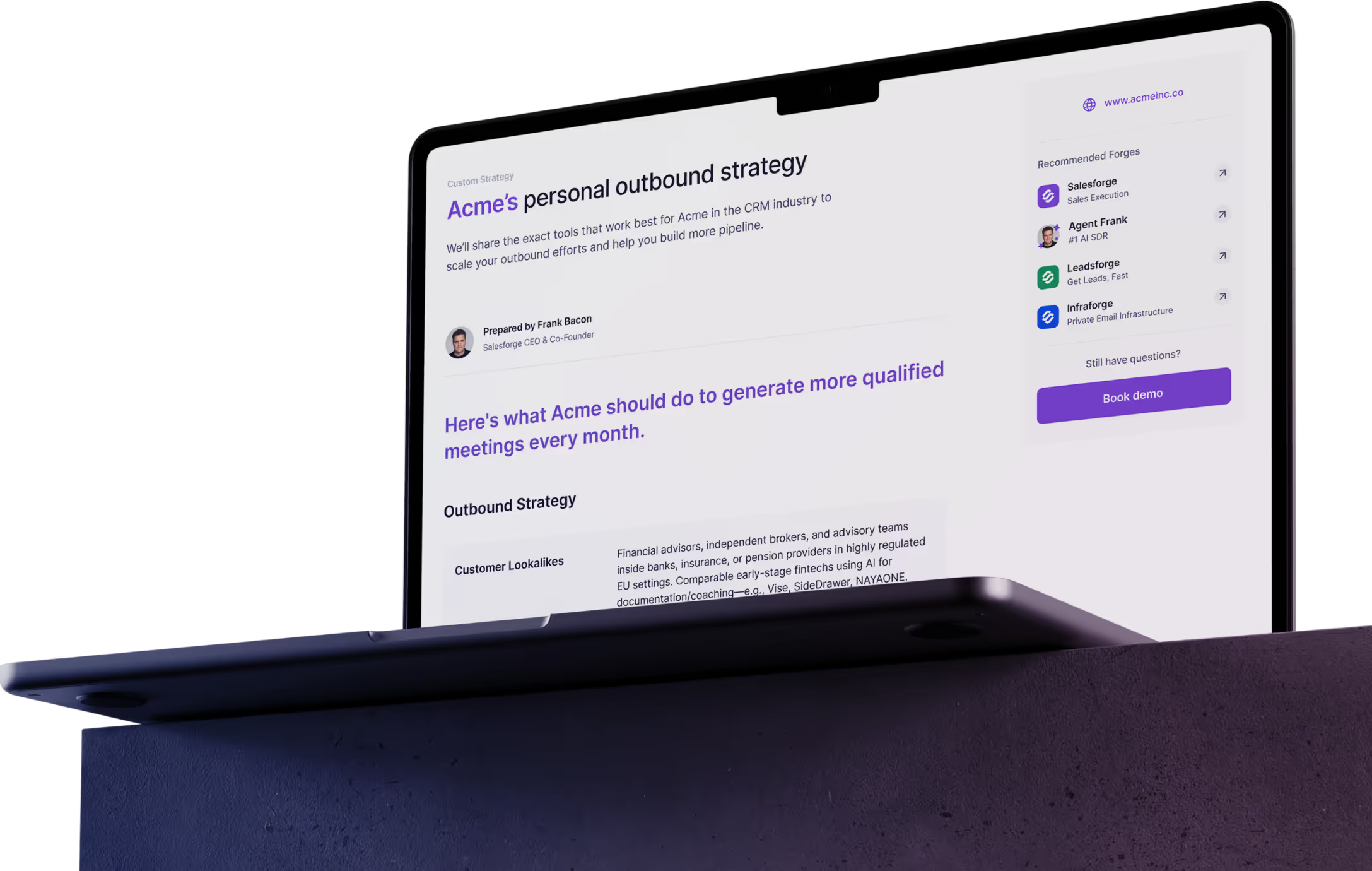
Get The Right Outbound Strategy In Minutes
Enter your email to get a custom plan & stack recommendation for your business
It's being carefully crafted by AI
Please check your mailbox in 5 minutes


When you look at both vendors it’s easiest to think in terms of scopes.
Alternatively, you can just let Salesforge's results speak for themselves:

Both platforms aim to support a centralized outreach workflow and campaign management, but Salesforge emphasizes delivering high inbox placement and friction-free multi-account sending while Reply.io leans into data and built-in AI workflows.
Salesforge provides 2 plans oriented around outreach scale, as well as a 14-day free trial.
The plans are as follows (with 2 free months granted when using annual billing):
Reply.io also provides multiple plans oriented around outreach scale plus a 14-day free trial.
The plans are as follows (with annual billing discounts available):
One of the most tangible differences that affects daily operations is how each product handles senders and accounts.
This is crucial when you’re trying to orchestrate multi channel outreach with many team members, when agency users want multiple accounts for clients, or when most sales teams prefer to map outreach to individual reps rather than restrict activity through tight license counts.
Teams running high-volume email outreach, multichannel engagement, or running several parallel campaigns for different verticals will find the unlimited-sender model reduces manual workarounds, simplifies domain setup, and makes campaign management less “account engineering” and more about messaging and testing.
Modern outreach is rarely email-only. Both platforms emphasize multiple communication channels and provide conditional sequences that span channels so you can follow a prospect through different touchpoints.
The practical upshot is that teams focused on multichannel engagement - especially those combining LinkedIn outreach and email automation - should compare how each tool implements follow-ups, channel fallbacks, and the ease of sending connection requests from multiple LinkedIn accounts.
Email deliverability is the silent deal-winner for cold outreach. Open rates, reply rates, and ultimately pipeline depend on whether messages land in the primary inbox.
Salesforge promotes a stack-of-products approach - including Warmforge for warm up and Mailforge/Infraforge/Primeforge for premium email infrastructure - and advertises free, unlimited warm up pools. The Primebox and Warmforge let you monitor mailbox health and inbox placement, which reduces the manual overhead of configuring DKIM, SPF and DMARC across multiple domains.
This is without even mentioning the other additional capabilities Salesforge offers to maximize email deliverability, such as:
Reply.io offers a deliverability toolkit, Gmail API sending, and free email warm-ups as part of its feature set, but the Forge approach bundles specialized infrastructure tools intended to be used in concert - a design that suits teams who want an integrated email automation and infrastructure playbook.
If you’ve struggled with third party mail servers, throttling, or inconsistent inbox placement, a platform that ties sending strategy to infrastructure (and makes warm-up a built-in workflow) materially improves campaign performance and lowers long-term operational risk.
Enter your email to get a custom plan & stack recommendation for your business
Please check your mailbox in 5 minutes
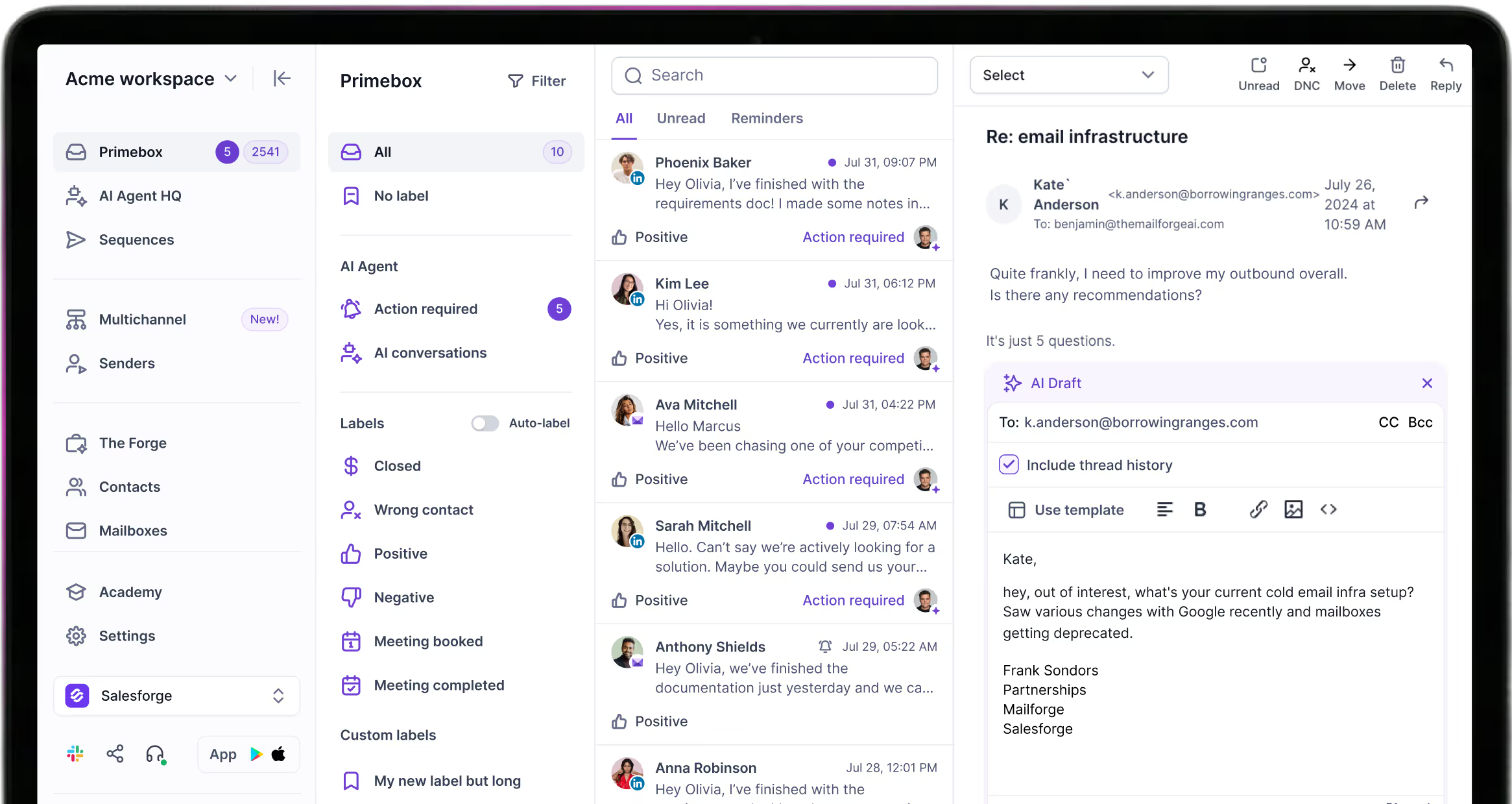
Handling replies is where outreach either turns into conversations or dies in noisy inboxes.
This centralized inbox model suits teams that want a single pane of glass for the entire sales process - from first email to booked meeting - removing the constant tab-hopping that eats time on a tight outbound cadence.
Both approaches work well for teams that need a centralized view, but Primebox’s marketing focus on capturing cross-address replies and integrating deliverability signals from the Forge Stack is a deliberate design for teams pushing high-volume, multi-domain campaigns. If your outreach efforts are spread across multiple mailboxes and LinkedIn accounts, a robust centralized inbox reduces manual data entry and keeps team member follow ups timely and relevant.
AI shows up in both products, but each vendor frames it differently.
A careful reading (and a wise procurement approach) treats these AI features as productivity multipliers - not magic. If you want to automate meeting scheduling, generate personalized email templates at scale, and reduce manual copywriting, both tools provide paths to get there.
Having a customer success manager (CSM) and strong support is often the difference between a dusty account and a campaign that scales.
For teams unfamiliar with cold outreach tools or those migrating from other platforms, a vendor that assigns a CSM, provides clear customer support channels, and helps configure complex deliverability settings and third party mail servers is invaluable. Salesforge’s emphasis on support plus infrastructure products (Warmforge, Infraforge) means a more operationally guided onboarding for teams that need help with domain, DKIM/SPF/DMARC setup and warm up - the very things that, if misconfigured, sink the best email outreach campaigns.
A cold outreach platform lives and dies by how smoothly you can build sequences, send follow ups, and measure campaign performance.
Follow ups are a crucial element of any outreach strategy - sequences that handle automated follow ups across channels (and that pause or branch when a connection is made, e.g., a LinkedIn acceptance or an email reply) reduce manual follow-up tasks and improve reply rates.
No outreach platform lives in isolation - you’ll plug it into calendars, CRMs, Zapier, and other third party tools.
Reply.io advertises a Chrome extension (Findy) to find emails on LinkedIn and Gmail, API access, Calendly/CRM integrations, and Zapier steps to connect other channels.
Salesforge also offers robust integrations + API access, but also ties CRM data into deliverability-aware outreach for guaranteed spam folder avoidance. Salesforge integrations include:
And many more. Salesforge is built to play cleanly with existing pipelines while keeping inbox and sender infrastructure consolidated.
Campaign performance is only useful when you can act on it.
For both platforms, the quality of analytics affects how fast you can iterate on personalized email templates and outreach campaigns. Crucially, the ability to gain valuable insights from unified reply data and deliverability signals determines whether your outreach is incremental-testing friendly or prone to repeating the same mistakes. If you care about conversion metrics like booked meetings per sequence, reply rates by channel, or pipeline value per campaign, compare both platforms’ analytics exports and dashboards to ensure they match the KPIs your sales and marketing teams report on.
Reply.io is an excellent fit when your primary needs are run of the mill AI-assisted personalization, and an interface tuned for multi channel conditional sequences that also features SMS and calling capabilities.
Teams that appreciate readily available Chrome extensions for quick email lookup and strong integration options (CRMs, Calendly, Zapier) will enjoy Reply.io’s all-in-one workflow.
Its published pricing plans and email volume tiers make it straightforward to model costs for a specific number of active contacts and campaign cadence.
However, if your team is running extremely high-volume email campaigns, wants to avoid seat-based licensing for LinkedIn senders, or needs stack-level deliverability control (Warmforge/Mailforge/Infraforge), then Salesforge’s infrastructure-first approach will feel more liberating operationally.
If deliverability, high-volume sending, and removing seat constraints are top of mind, Salesforge’s stack-centric approach is compelling.
Teams that need unlimited active mailboxes and LinkedIn senders for unlimited seats, centralized reply management (Primebox), and unlimited free native warm up (via Warmforge) will find fewer operational frictions - fewer third party mail servers to patch together, less manual domain configuration, and cleaner inbox placement.
Agencies and growth teams that run multiple accounts and want whitelabel options or private infrastructure will value the Forge Stack’s modularity: Leadsforge for targeted prospect lists, Mailforge/Infraforge/Primeforge for infrastructure and Warmforge for warm-up.
Salesforge emphasizes support and hands-on onboarding for domain setup and deliverability optimization - the kinds of behind-the-scenes tasks that actually determine whether your email outreach campaigns scale or burn out.
For teams that measure success by booked meetings, pipeline velocity, and consistent inbox placement rather than just the number of emails sent, Salesforge’s approach can produce steadier long-term outcomes.
Salesforge’s site advertises unlimited mailboxes, LinkedIn senders and workspaces on its Growth tier, which removes seat-based limits and simplifies scaling outreach campaigns and email campaigns across sales teams and agencies. That means less account engineering when running multichannel outreach and easier mapping of reps to outreach workflows; Reply.io uses per-user/active-contact pricing models that are more seat-centric.
Salesforge positions a Forge Stack with dedicated deliverability tooling - Warmforge for warm-up, Mailforge/Infraforge for private infrastructure, dynamic IPs, ESP matching and mailbox rotation to protect sender reputation and improve inbox placement. This infrastructure focus targets long-term deliverability for large email volumes vs. stitching multiple third party tools.
Salesforge bundles Leadsforge (a built-in lead search engine) and advertises promotional free credits to help build targeted prospect lists inside the same stack, shortening the path from lead generation to outreach. Reply.io also provides live data credits for prospecting, but Salesforge emphasizes an integrated lead-search → send workflow within one sales engagement platform.
Salesforge explicitly markets Whitelabel and Infraforge Whitelabel (resell private cold-email infrastructure and branded outreach), aimed at agencies that want to sell infrastructure and services. Reply.io also offers a white-label / partner program for agencies, but Salesforge highlights whitelabeling at the infrastructure level (private SMTP/IP/resellable infra) as a distinctive option.
Pick Salesforge when deliverability, unlimited users/mailboxes and integrated infra (warm up + private IPs) are top priorities for scaling high-volume sales outreach across email + LinkedIn automation. Choose Reply.io if you want a mature sales engagement tool with built-in live data credits, polished multichannel sequences (email, LinkedIn, calls, SMS) and a straightforward pricing plan for teams focused on rapid list building and sequence A/B testing.