
Personalized Outbound Strategy
Get The Right Outbound Strategy In Minutes
Enter your email to get a custom plan & stack recommendation for your business
It's being carefully crafted by AI
Please check your mailbox in 5 minutes

For a thorough understanding of what each option offers, a simplified comparison table isn't enough to grasp all intricacies that come with each tool, so let's dive deeper into what makes Octopus CRM and Salesforge unique.
It’s marketed to people who want to run outreach campaigns directly from browser extension workflows and connect easily to Zapier, Google Sheets, or other CRM systems.
If your outreach relies as much on email as on LinkedIn outreach, Salesforge is pitched as the more complete solution. You can let the results speak for themselves:

Octopus CRM provides 4 plans and a free trial as well (with an annual billing discount available):
Salesforge provides 2 plans oriented around outreach scale and a 14-day free trial as well (with 2 free months granted when using annual billing):
Salesforge’s automation reaches across the LinkedIn funnel into email capture, sequence personalization, validation, and analytics. Octopus CRM focuses on LinkedIn account activity and LinkedIn message automation.
Both provide tracking and campaign statistics, but Salesforge’s stack is designed to reduce delivery friction across channels while Octopus CRM excels at standard individual-user LinkedIn outreach.
A cold outreach campaign’s best-laid plans fail if messages never reach your email recipients’ primary tab.
Salesforge also offers such LinkedIn account safety measures, but also addresses email deliverability with:
And many more features meant to manage sending reputation and improve inbox placement.
So if your outreach strategy depends heavily on email follow-ups, bounce control, and inbox placement inside a full lead generation funnel, the Salesforge approach gives concrete advantages for email deliverability that Octopus doesn’t address.
Octopus CRM supports personalized connection requests and message templates you can use at scale - personalized messages to LinkedIn profiles often work better than generic blasts. It’s also easy to create campaigns that target LinkedIn contacts, leverage LinkedIn Sales Navigator filters, and send personalized connection requests and follow-ups.
Salesforge layers in AI-powered multi-source hyper-personalization for both email and LinkedIn messages: AI-generated customized emails, A/B testing, personalization credits and more, so each prospect gets a tailored approach without manual copy changes.
Because Salesforge integrates personalization with email validation and campaign analytics, the AI output can be fed into sequences that respect send limits and warm-up rules, preserving the “human behavior” feel while scaling.
Octopus CRM is perfectly capable of creating personalized LinkedIn messages using placeholders and scripts inside campaigns, but Salesforge’s point of differentiation is the AI assist combined with a delivery-first stack, which tends to produce more positive results and easier scaling across both LinkedIn and email channels.
Automation on LinkedIn is powerful but risky if not governed by human-like behavior.
If you run many outreach campaigns and need multiple profiles or multiple campaigns per account, Octopus CRM is attractive for quick setup and immediate results, but Salesforge is a better fit when you want to combine LinkedIn outreach with validated email follow-ups for higher conversions.
Enter your email to get a custom plan & stack recommendation for your business
Please check your mailbox in 5 minutes
Both platforms understand the need to integrate with CRM systems and external workflows, though to different extents.
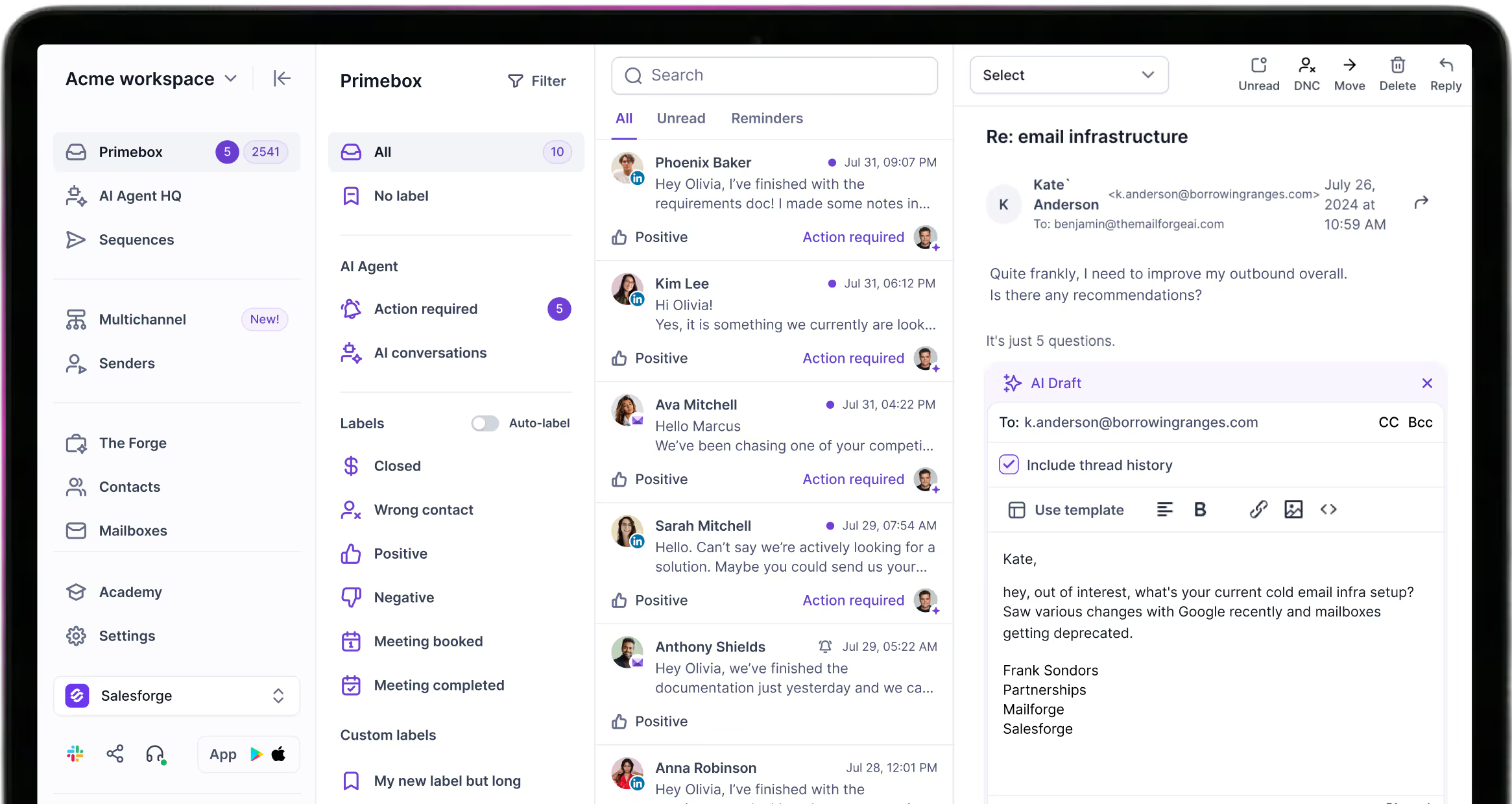
Salesforge supports many more native integrations, but one important distinction is the proprietary Forge Stack, which keeps prospect data, campaign history, and inbox conversations aligned so that when a lead moves to opportunity stage the handover is seamless. Notable Salesforge integrations include:
And many more. If your priority is to keep the team aligned and ensure prospects are tracked consistently in your CRM, Salesforge covers the essentials while emphasizing consolidated data and comprehensive campaign tracking.
It’s useful for recruiters and sales professionals who need quick, albeit basic insight into which LinkedIn message templates are working.
Where Octopus gives immediate metrics and a basic dashboard, Salesforge offers a more sophisticated analytics set that ties campaign stats to deliverability and inbox metrics. Salesforge’s analytics help diagnose whether a low reply rate stems from message copy, targeting, or poor inbox placement.
If integrated multi-channel control and long-term inbox health matter to your team, Salesforge’s centralized UX pays off.
Octopus CRM is a fit for individual sales professionals and small teams who need a low-cost LinkedIn outreach tool, quick campaign creation, or just the ability to do more unique LinkedIn actions such as auto-endorsing skills.
Its starter plan and cheap tiers make it attractive for outreach experiments and for teams wanting a personal CRM layer over LinkedIn, though the features are fairly limited to reflect the pricing.
Salesforge is suited for sales teams and agencies of all sizes that require multi-channel outreach, advanced deliverability (including unlimited free warm-up), prioritized 24/7 support, proprietary infrastructure, and AI hyper-personalization at scale.
If your outreach is following the meta of mixing LinkedIn outreach with email sequences, Salesforge’s stack is a great fit.
Both Octopus CRM and Salesforge are strong in their niches:
If your priority is low-cost LinkedIn automation and quick campaign setup, though with questionable outreach results, Octopus CRM is a decent choice.
If your priority is a reliable, scalable, deliverability-first multi-channel pipeline that connects LinkedIn outreach to validated email sequences and reduces the risk of bounces and poor inbox placement, Salesforge is the superior option.
Salesforge is a deliverability-first, multi-channel stack (email + LinkedIn) with AI hyper-personalization; Octopus CRM is a lightweight Chrome extension focused on LinkedIn automation and bulk messaging. Octopus CRM extension is great for quick LinkedIn lead generation and profile actions, while Salesforge ties LinkedIn profiles and connections into validated email follow-ups, warm-up, and campaign analytics. Try both with their free trial windows to see which fits your outreach efforts.
Yes - Salesforge is designed to ingest LinkedIn leads (including Sales Navigator results), enrich profiles, and push contacts to sequences. It integrates with automation tools via API, webhooks and native CRM connectors, making it easier to turn LinkedIn leads into multichannel outreach. Compared to simple CSV exports from Octopus CRM, Salesforge aims to automate enrichment and delivery so leads are ready for follow-up.
Salesforge supports both: LinkedIn free users can still benefit from lead capture and sequences, while LinkedIn Premium/Sales Navigator users unlock richer targeting and higher-quality LinkedIn lead generation. Salesforge also emphasizes account safety to comply with LinkedIn corporation rules so automation behaves human-like. Ideal target audience: teams/agencies who want to scale outreach while protecting accounts and improving meeting conversion.
Salesforge enriches LinkedIn leads, validates emails, warms mailboxes, and automates multi-step sequences so LinkedIn leads flow into a tracked marketing funnel. Octopus CRM extension focuses on LinkedIn connections and exports; Salesforge adds deliverability, analytics and unified inbox features to convert LinkedIn leads into meetings and pipeline with less manual handoff.
Yes - Salesforge consolidates LinkedIn automation, email deliverability (Warmforge), lead enrichment, and analytics into one stack, reducing the need for patching multiple automation tools. For low-cost experiments or single-user LinkedIn automation, Octopus and other free tools work; for scaling outreach, Salesforge’s unified approach, integrations, and free trial make it easier to centralize LinkedIn leads, profiles, messages, and campaign reporting.