
Personalized Outbound Strategy
Get The Right Outbound Strategy In Minutes
Enter your email to get a custom plan & stack recommendation for your business
It's being carefully crafted by AI
Please check your mailbox in 5 minutes


For a thorough understanding of what each option offers, a simplified comparison table isn't enough to grasp all intricacies that come with each tool, so let's dive deeper into what makes Linked Helper and Salesforge unique.
Linked Helper positions itself as a desktop app designed specifically to automate LinkedIn outreach workflows (connection requests, message chains, post engagement, scraping, and email finder capabilities). Linked Helper emphasizes safety as a differentiator, saying the app “is programmed like a browser” and does not inject code into LinkedIn pages.
Linked Helper also advertises an inbuilt email finder and the ability to export results to CSV for CRM integration.
Salesforge, built by a former Googler and VP of sales, offers all of Linked Helper's capabilities, but with additional multi-channel functionality that combines LinkedIn outreach with email outreach. Salesforge puts a bigger emphasis on the whole outreach stack - domain setup, email warm up and deliverability, and sequence orchestration - rather than just standard LinkedIn actions.
A notable Salesforge selling point is unlimited LinkedIn senders, mailboxes, workspaces and seats, making it the perfect place to run multi-channel outreach at scale.
Alternatively, you can just let Salesforge's results speak for themselves:

Both vendors talk about “automating lead workflows”, but they approach the job from different angles: Linked Helper is solely a LinkedIn automation specialist, while Salesforge aims to be an end-to-end outreach platform spanning both LinkedIn and email.
When you evaluate automation features, think about the specific repetitive tasks you want to automate: sending connection requests, follow-ups, drip campaigns, post engagement, scraping profile data, etc.
Salesforge approaches automation from a multi-channel perspective.
For teams that want to coordinate LinkedIn outreach with email follow-ups and track messaging history across channels, Salesforge’s approach reduces context-switching between a LinkedIn automation desktop app and separate email tooling.
Linked Helper provides 2 plans oriented around outreach scale, as well as a 14-day free trial. The plans are as follows (with discounts up to 45% off depending on billing):
Salesforge provides 2 plans oriented around outreach scale and a 14-day free trial as well (with 2 free months granted when using annual billing):
Multi-channel outreach outperforms single-channel outreach by reaching prospects where they engage, boosting response rates, reducing reliance on one deliverability/safety risk, and enabling personalized, coordinated touchpoints across multiple channels.
Linked Helper also includes an email finder tool and CSV export to bridge to email, but that’s auxiliary to the core LinkedIn automation feature set.
If your outreach campaigns stick to the format of sending connection requests as the first touch, then following up by email, Salesforge tackles it perfectly.
Account safety and respecting LinkedIn limits should be a top priority - if you trigger LinkedIn’s anti-automation systems, you risk pending invitations, temporary restrictions, or account flags that damage network growth.
For teams managing multiple LinkedIn accounts, Linked Helper’s desktop approach and limits make per-account control straightforward, although with seats scaling with pricing, the incurred costs can become pretty steep.
Salesforge’s advantage is unlimited LinkedIn senders, mailboxes and even seats, which encourages enterprise practices that reduce spammy signals when you pair LinkedIn outreach with high-quality email sequences.
Email deliverability is mission-critical when outreach campaigns include email - poor deliverability can torpedo lead generation efforts.
Salesforge places deliverability front and center:
Good infrastructure and warm-up reduce spam placement and increase pipeline coverage when you run email sequences alongside LinkedIn outreach.
Linked Helper includes an inbuilt email finder tool and ability to export emails to CSV, but it does not present any native email deliverability capabilities.
Managing messaging history and newly added connections is central to consistent prospecting.
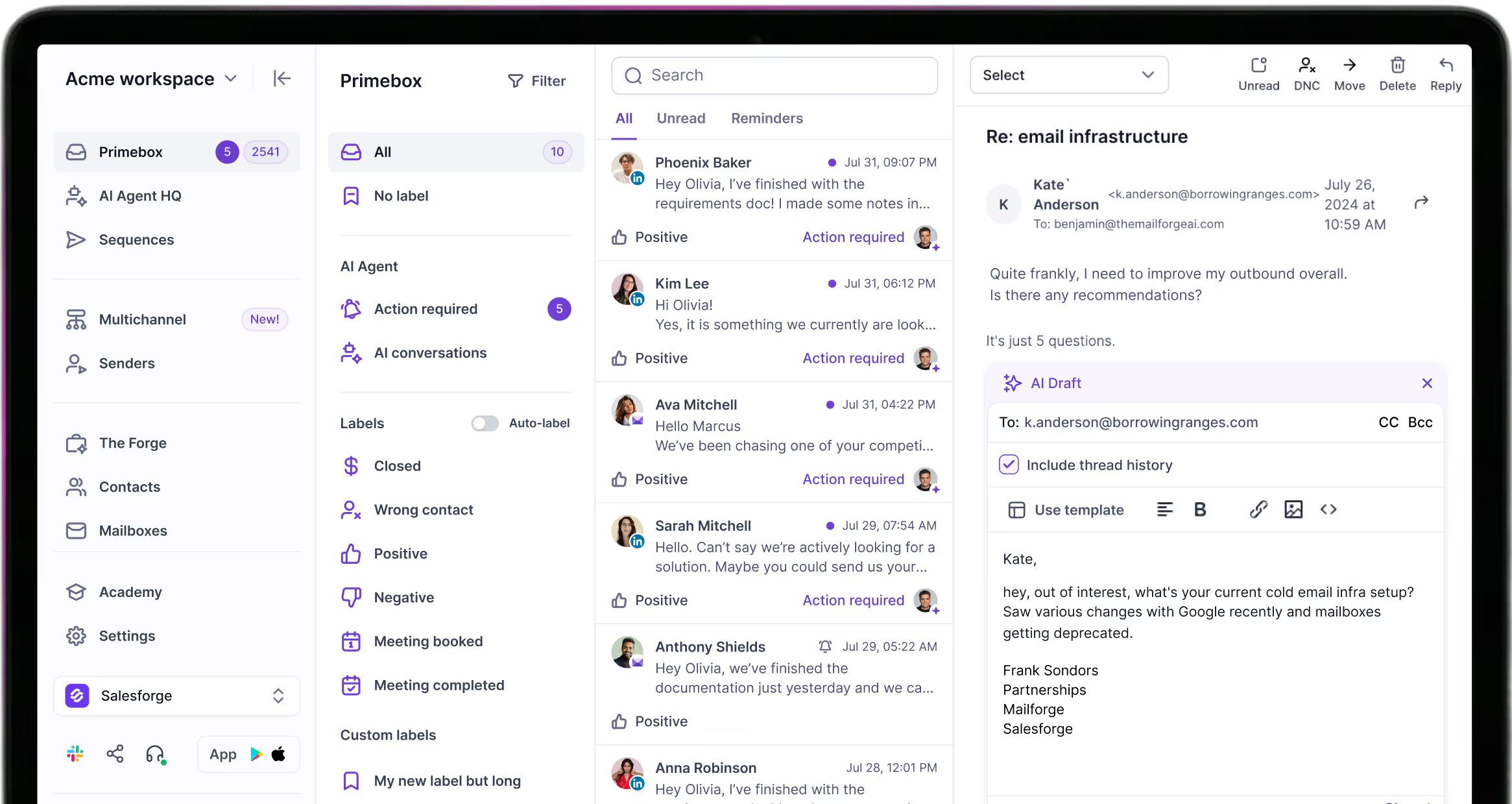
For teams that run both LinkedIn outreach and email follow-ups, Primebox reduces all friction: you don’t have to sync a separate CRM to see whether a prospect replied on LinkedIn or responded via email.
Linked Helper CRM is good for LinkedIn-native tracking and exporting CSV files for other systems, but Salesforge aims to be the single place to manage outreach replies across channels - valuable when you automate lead workflows and outreach campaigns that cross email and LinkedIn, and even more seamless if you use solely Forge products to automate every prospecting step.
Enter your email to get a custom plan & stack recommendation for your business
Please check your mailbox in 5 minutes
Linked Helper highlights: custom variables, the option to attach personalized images, and a smart message template editor to build flexible templates that can dramatically increase acceptance and reply rates. It explicitly promotes sending personalized messages to LinkedIn accounts, group members, and Sales Navigator targets, and supports personal variables to scale hyper personalization.
Salesforge also supports hyper-personalized outreach but frames it inside conditional multi-channel sequences and AI-assisted crafting. Salesforge’s advantage is that multi-source AI hyper-personalization can feed into multi-touch sequences that escalate from connection requests to email - so you can use personalized LinkedIn messages as one step of a larger drip campaign.
If you want those personalized messages to trigger downstream email sequences, Salesforge links personalization to cross-channel orchestration - a practical benefit when your outreach efforts require coordinated touchpoints for lead generation.
Both tools understand that outreach rarely lives in isolation - data needs to flow.
Beyond that, notable Salesforge integrations include:
And many more. Salesforge is built to play cleanly with existing pipelines while keeping inbox and sender infrastructure consolidated.
Accurate reporting and analytics let you optimize outreach campaigns and improve conversion.
Salesforge’s focus is to offer analytics that not only show campaign performance but also highlight deliverability and mailbox health - valuable insights if you’re measuring both LinkedIn outreach metrics (connection requests, acceptance rates, replies) and email metrics (open rate, inbox placement).
How steep is the learning curve? Well, Linked Helper packs many knobs and options - multi-source targeting, 31 tools in the toolkit, the ability to construct complex funnels with chains of messages and so on. Teams that want depth will appreciate the control but should expect a decent configuration effort (moreover, being a desktop app adds another layer of setup)
Salesforge intentionally offers simplicity around running multi-channel campaigns.
Salesforge emphasizes easy to use multi-source AI hyper-personalized templates, a centralized inbox, free integrated warm up and mail management, and an active Slack community + Academy content to flatten onboarding. Despite having robust features, Salesforge's intuitive interface is positioned for teams that want scalable outreach without piecing together many separate tools and struggling long with setup.
Linked Helper prominently states “instant 24/7 support” and a broad knowledge base with support articles and webinars.
Salesforge offers superior 24/7 email and live chat customer support and provides a help desk, video tutorials, Salesforge Academy, a community Slack, weekly AMA sessions and dozens of case studies that emphasize hands-on help optimizing strategy.
If your priority is troubleshooting for a desktop LinkedIn tool, Linked Helper’s instant support promise is compelling. If you’re managing cross-channel campaigns and want instant or consultative help, Salesforge’s combination of academy content, community, and hands-on onboarding support can feel more strategic.
For teams that run outreach efforts almost entirely inside LinkedIn and rely on CSV exports and an embedded email finder, Linked Helper’s toolkit is purpose-built for those needs.
Salesforge’s Primebox and deliverability tooling are especially helpful when you automate lead workflows and want to avoid missed replies, its unlimited sender model is an obvious advantage for scaling organizations, and the whitelabel offering showcases care towards agencies as well.
There’s no one correct answer - both tools are powerful and proven.
If you want a LinkedIn automation specialist with a deep feature set for LinkedIn outreach, Linked Helper is a feature-rich LinkedIn automation software to consider.
If your objective is to run multi-channel outreach campaigns at scale - Salesforge leans into those problems and offers practical and affordable scalability + centralized reply management that reduces friction across outreach campaigns and next level hyper-personalization at scale.
Efficient consolidation, unlimited LinkedIn senders, warm-up and email deliverability, robust integrations, and a single place to manage replies - if your outreach includes significant email follow-ups or you plan to scale across multiple LinkedIn accounts and senders, Salesforge is the more strategic choice.
Either way, use trials, test real CSV lists and sequences, and measure acceptance rates, reply rates and inbox placement before you commit - those metrics will tell you which tool truly moves the needle for your lead generation and outreach campaigns.
Yes. Salesforge is a multi-channel outreach automation tool that serves as a strong Linked Helper alternative - it covers LinkedIn automation while adding email deliverability, unified inbox (Primebox), and orchestration, making it suited for LinkedIn lead generation and teams scaling beyond single-channel tools.
Salesforge supports LinkedIn outreach (connection requests, messaging and history) and coordinates those touches with email. For LinkedIn group members, LinkedIn connections, and post engagement tools you may still use Linked Helper or other LinkedIn automation tools in parallel, but Salesforge centralizes replies and cross-channel follow-ups for better lead generation.
Linked Helper focuses on LinkedIn automation and deep platform actions; Salesforge prioritizes multi-channel sequences (LinkedIn + email) and deliverability. For pure LinkedIn workflows Linked Helper/Linked Helper 2 shines; for higher reply rates, coordinated funnels and cross-channel lead generation, Salesforge outperforms many other automation tools.
Salesforge emphasizes API, native CRM integrations, webhooks and Zapier rather than a browser Chrome extension. Linked Helper (desktop/browser-simulating tools) often expose CSV exports and in-client scraping. If you need a Chrome extension specifically, Linked Helper and some other LinkedIn automation tools may be preferable - Salesforge focuses on integration and orchestration.
Salesforge provides 24/7 email and live chat, onboarding, an Academy, and an active Slack community for more hands-on help - positioned to offer exceptional customer support compared with many other automation tools. Linked Helper also offers 24/7 email and community resources, but Salesforge emphasizes consultative support for multi-channel campaigns.