
Personalized Outbound Strategy
Get The Right Outbound Strategy In Minutes
Enter your email to get a custom plan & stack recommendation for your business
It's being carefully crafted by AI
Please check your mailbox in 5 minutes


For a thorough understanding of what each option offers, a simplified comparison table isn't enough to grasp all intricacies that come with each tool, so let's dive deeper into what makes Klenty and Salesforge unique.
Where Salesforge stands out is its integrated Forge Stack - Warmforge for warm-up, Mailforge/Infraforge/Primeforge for infrastructure, Leadsforge for lead generation, and Agent Frank for an optional, fully autonomous AI SDR. It is perfectly designed to seamlessly connect every sales outreach step.
If your sales strategy depends on mixing LinkedIn outreach with cold emails and wanting proprietary infrastructure that prevents emails going to spam, Salesforge emphasizes that stack. If your priority is dialing, call coaching and integration-triggered cadences, Klenty’s tools can be compelling.
Alternatively, you can let Salesforge's results do all the talking:

Klenty provides multiple seat-based plans oriented around outreach scale and offers a 14-day free trial (no monthly billing, only quarterly and annual).
Salesforge provides 2 plans oriented around outreach scale and a 14-day free trial as well (with 2 free months granted when using annual billing):
Both platforms offer automated follow ups and cadence builders, but they lean toward different strengths.
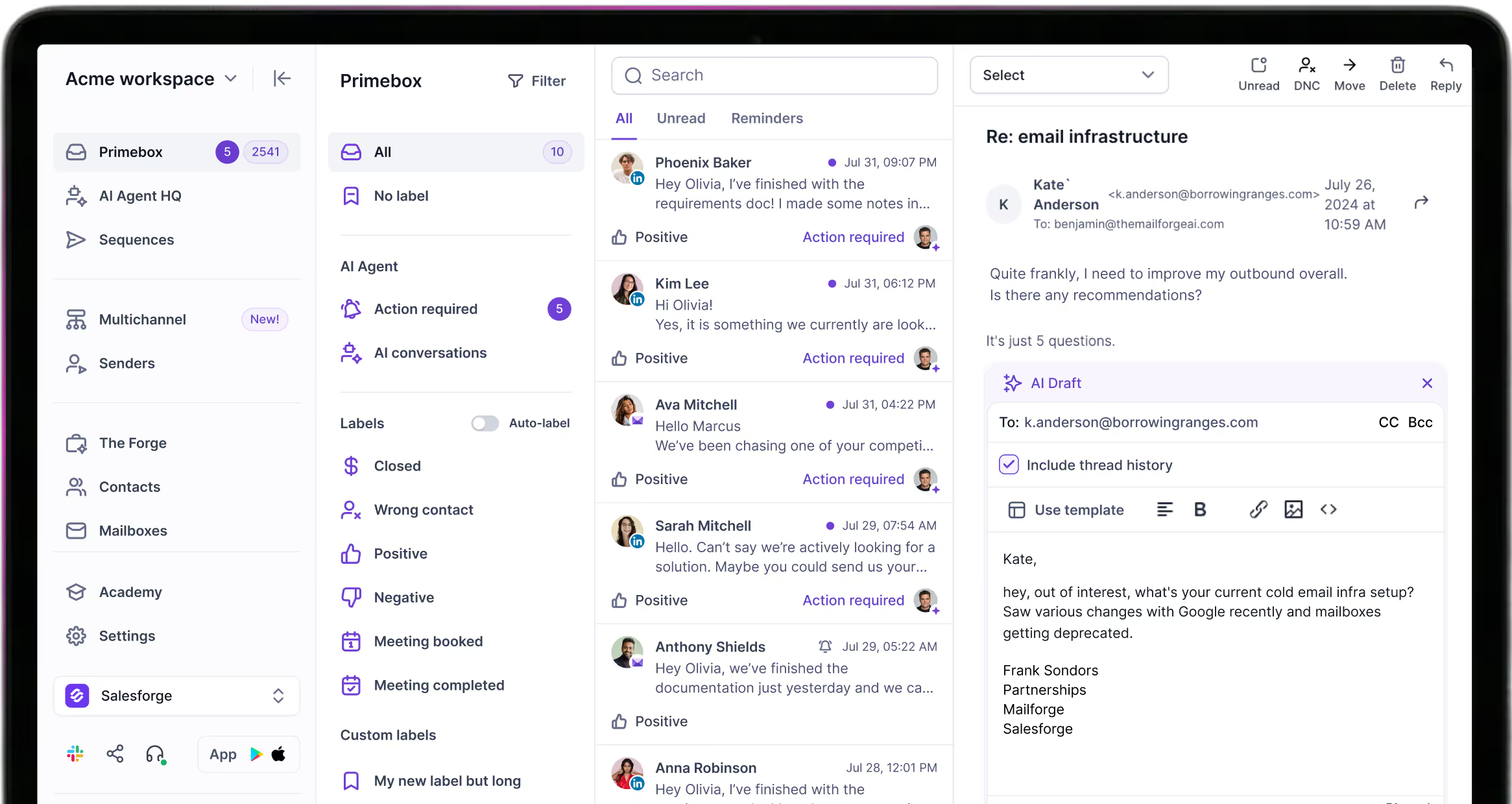
Salesforge focuses on enabling automatic personalized sending at scale with unlimited mailboxes and senders, but another notable advantage in its favor is the Primebox - a unified reply inbox that helps manage conversations across multiple channels in one place and assures that no leads slip through the cracks.
Klenty highlights AI account research and list-building tools that let sales teams perform account research and generate highly tailored email copy and cadences.
Salesforge emphasizes its state-of-the-art multi-source AI hyper-personalization via multi-language messaging and spintax utilities.
In practice, if your outreach playbook depends on extremely over-the-top account research to improve reply rates, Klenty’s AI-assisted research will feel useful. Salesforge, meanwhile, combines advanced personalization with powerful deliverability tooling and mass-scale sending capabilities so that messages reach as many prospects as possible while maintaining high quality results.
Klenty advertises an email deliverability suite that monitors domain and inbox health and includes basic warm-up features to help emails land in primary tabs.
Salesforge, however, places deliverability at the center of its product by bundling:
And more with Mailforge (shared), Infraforge (private) and Primeforge (Google/Outlook) - infrastructure products that aim to give teams a premium selection depending on their infrastructure needs.
Salesforge reduces the guesswork: advanced deliverability capabilities, mailbox heat score monitoring, and a path to scale unlimited mailboxes while preserving inbox placement. Klenty provides basic deliverability tooling, but Salesforge takes it to the next level.
How platforms charge and scale with sales reps matters operationally.
Ambitious sales teams that seek to expand sending capacity quickly (more mailboxes, more LinkedIn senders, more outreach accounts) will prefer Salesforge’s unlimited-sender framing so they can grow outreach volume and reach more prospects without incremental licensing friction.
Klenty highlights integrations with major CRMs (Salesforce, HubSpot, Zoho, Pipedrive, MS Dynamics) and Zapier to connect with dozens more.
Salesforge supports many more native integrations, but one important distinction is the proprietary Forge Stack, which keeps prospect data, campaign history, and inbox conversations aligned so that when a lead moves to opportunity stage the handover is seamless. Notable Salesforge integrations include:
And many more. If you desire enterprise-scale integrations at smaller-sized sales team pricing, Salesforge will be preferable.
Enter your email to get a custom plan & stack recommendation for your business
Please check your mailbox in 5 minutes
Klenty markets analytics that help sales teams measure cadence effectiveness, track reply rates, and identify areas where sequences need refinement - it’s built to help sales managers evaluate how sales reps perform, which cadences close deals, and how email campaigns are progressing.
Salesforge provides campaign-level metrics too (response rates, opens, replies, etc.) and layers in infrastructure-focused telemetry (Heat Score, inbox placement tests, other analytics tied to deliverability).
Where Klenty focuses on conversion-oriented reporting for reps and managers, Salesforge’s analytics additionally include thorough deliverability and infrastructure diagnostics that help teams identify areas where sending setup, domain health, or warm-up might be limiting campaign performance.
Sales teams succeed by quickly managing replies and converting leads.
For sales managers just trying to shorten the time to respond, Klenty’s CRM-linked reply tracking is great.
For teams that mix LinkedIn outreach with email and need to avoid losing threads when prospects reply from different addresses, Salesforge's Primebox is a unique selling point that reduces manual work and helps keep building relationships coherent across channels.
Klenty emphasizes various resources tailored for sales teams: demos, an academy, documentation and a product hub to get sales reps executing cadences quickly.
Salesforge advertises the Salesforge Academy, an active Slack community, many tutorials, a robust knowledge base, and hands-on 24/7 email and live chat support.
If your team ever needs help, night or day, with anything from technical setup to running large email campaigns while maintaining deliverability, Salesforge offers superb 24/7 premium support and documentation.
Klenty is positioned as a SaaS sales engagement platform with direct integrations to CRMs. It focuses on enterprise-grade features like CRM sync and analytics.
Salesforge also provides these workflows but highlights whitelabel opportunities and proprietary infrastructure options via Mailforge, Infraforge and Primeforge - useful for agencies or businesses that want to control domain reputation tightly and even whitelabel the tools.
Both vendors treat security and deliverability seriously, but Salesforge’s messaging explicitly ties whitelabel and private infrastructure to improved deliverability, which can be a deciding factor for teams handling high-volume outbound sales for clients.
For sales managers building outbound sales playbooks:
Pick Klenty if your priority is CRM-first cadences, over-the-top account research and built-in dialer functionality.
Pick Salesforge if your priority is scaling outbound sales with hyper-personalized messages through unlimited mailboxes and LinkedIn senders, with ensured email deliverability and consolidated replies within the Primebox.
Salesforge’s Forge Stack is particularly compelling when the sales strategy is volume-driven and “emails land” is non-negotiable - it solves both technical deliverability problems and campaign orchestration for teams intent on building relationships and closing deals at scale.
Salesforge centers on multi-channel scale (email + LinkedIn) with infrastructure for deliverability and mass sending plus built-in warm-up and unified replies. Klenty is CRM-first, strong at account-based cadences and dialing features. Use Salesforge for volume and inbox placement; pick Klenty if you need deep CRM sync and account research.
Yes - Salesforge supports automated sequences (cold emails into follow ups), mailbox rotation and tracking so website visitors and prospects feed campaigns. Automation respects suppression lists and recipient preferences; you can route responses into the Primebox or CRM to convert prospects into customers without manual touchpoints.
Salesforge emphasizes infrastructure (warm-up, dynamic IPs, mailbox rotation) to preserve inbox placement when sending personalized emails at scale and to manage unsubscribe/preference handling. Klenty focuses more on personalization and cadence control inside a CRM. For very large, multi-mailbox programs, Salesforge typically reduces deliverability risk.
Salesforge’s unified inbox (Primebox) aggregates replies across channels so conversations stay coherent even if prospects reply from different addresses or LinkedIn. Klenty syncs replies into CRM records and pauses sequences, which works well for CRM-driven teams but can be less unified across non-email channels.
Choose Salesforge if you need volume, multi-channel reach, advanced deliverability and unified reply management to convert many website visitors into customers. Choose Klenty if your sales process is CRM-centric, needs deep account research/personalized cadences and built-in dialer features for higher-touch prospect engagement.