
Personalized Outbound Strategy
Get The Right Outbound Strategy In Minutes
Enter your email to get a custom plan & stack recommendation for your business
It's being carefully crafted by AI
Please check your mailbox in 5 minutes


For a thorough understanding of what each option offers, a simplified comparison table isn't enough to grasp all intricacies that come with each tool, so let's dive deeper into what makes Klenty's SDRx and Salesforge's Agent Frank unique.
Both Agent Frank and SDRx position themselves as AI SDRs designed to augment or automate outbound and inbound prospect engagement, but they arrive at that promise from different stacks.
That architecture is framed as removing dependencies on third-party providers for deliverability and lead sourcing, and it’s one reason Salesforge emphasizes less overhead and increased ROI for sales teams.
Agent Frank, built by a former Googler and VP of sales, is the perfect way to completely automate the entire process. It offers:
All of which reduce friction in the outreach process and increase reps-focused productivity.
Still doubtful? Let Agent Frank's results speak for themselves:

SDRx highlights immediate ramp and independence of data access. It uses a massive prospecting database to create account lists and extract pre-validated contact data, and advertises deep account research and business-case generation for each account, similarly to Agent Frank.
SDRx also calls out done-for-you deliverability work such as sub-domain purchasing, inbox rotation, warm-up, and frequency randomization - features aimed at optimizing email deliverability and sender reputation without forcing the customer to build out an infrastructure stack.
Agent Frank provides flexible pricing oriented around outreach scale. Pricing is charged by Active Contacts (the number of prospects the Agent is processing at any given time), and annual billing includes 2 months free. There is no free trial and demos are required before purchase.
Note that infrastructure to process those contacts via email is not included in this base price. The Salesforge Stack offers multiple infrastructure options based on your budget/needs, so you don't need to stitch third-party products to make it work. The best options for Agent Frank include:
The Forge team will help set up the mailboxes and, additionally, the Mailforge (shared IP) and Primeforge (Gmail and Outlook) email infrastructure options are also available. Additionally, teams can connect their own mailboxes from other providers if desired.
SDRx requires booking a demo for pricing details.
Onboarding speed and ramp time matter because “time to first meeting” converts directly into business case arguments for buying an AI SDR.
Agent Frank’s onboarding is consultative and intentionally hands-on.
That means Agent Frank may hit full outbound velocity on day one and, by combining infrastructure setup with a knowledge-base trained AI, Agent Frank reduces deliverability risk and maintain outbound quality over time.
Account research drives quality personalization, and both products highlight it - but their emphasees differ in meaningful ways.
They access their massive proprietary prospecting database to create account lists and extract contact data for outreach. This strong data foundation is why SDRx leans on the “zero-to-engage” narrative.
Agent Frank further focuses on hyper-personalization through its uploadable knowledge base and active prospect signals.
Both vendors emphasize AI account capabilities and multiple data inputs, but Agent Frank sells a more tightly integrated knowledge-driven multi-source hyper-personalization loop with seamlessly automated lead generation, verification and qualification.
Enter your email to get a custom plan & stack recommendation for your business
Please check your mailbox in 5 minutes
Deliverability and infrastructure are where differences become operationally decisive. Deliverability is the linchpin of cold outreach success - a brilliant sequence is worthless if emails land in spam - and this is one area where Agent Frank intentionally differentiates itself.
And more. Building sender reputation gradually while spreading volume across addresses and IPs to avoid single-mailbox throttles or sudden reputation hits is crucial for a scaling business. And that's paired with proprietary infrastructure options:
Those infrastructure features reduce the risk of landing in spam and make multi-channel outreach more reliable, especially when you have a leads database and want to integrate email at scale.
SDRx advertises done-for-you email deliverability that includes:
Those features are packaged so teams don’t have to stitch together a deliverability strategy themselves, but leaves dependence with Klenty and if anything goes wrong, you'll have a lesser immediate ability to solve the issue.
For sales teams or lead generation agencies focused on large scale operations and high-volume cold outreach, Agent Frank’s model minimizes the operational burden of maintaining email metrics, domain health, and warm-up cycles so teams can scale sends across many mailboxes with less risk.
That combination helps raise connect rates and diversify touchpoints so prospects who ignore email can still be reached on LinkedIn or through other signals.
SDRx also references additional agents (like calling agents) for inbound booking.
Customer support is a practical part of the business case for any AI SDR - support quality affects onboarding speed, how reps adopt the tool, and how quickly you can scale outreach without damaging sender reputation or interrupting the outreach process.
SDRx presents a more productized, resource-driven support approach: their site emphasizes access to:
And drives prospects to schedule a demo as the primary engagement channel. Klenty additionally offers email and live chat support and a dedicated account manager when you become a client.
SDRx’s public materials focus heavily on operational enablement and on making the AI train itself on your business, while demos are the main route to getting the agent connected and supported in your CRM workflow.
Salesforge's approach further reduces the manual tasks sales teams often struggle with - no separate deliverability vendor, fewer manual data entry steps, and a partner focused on ironing out initial list hygiene and infrastructure.
Besides that, Agent Frank customers also get:
For growing sales teams and lead generation agencies that prefer to shift heavy operational overhead away from internal staff, Agent Frank’s model is a strong fit.
They offload the manual tasks that consume SDR time and let reps focus on higher-value activities like closing deals and handling qualified leads.
If your sales org treats deliverability, sender reputation, and long-term pipeline health as strategic assets, if you want an AI SDR that arrives with a managed infrastructure, a dedicated account manager, and a controlled warm-up and multi-ESP sending plan - Agent Frank is designed precisely for that.
Salesforge’s model of bundling the Forge Stack with Agent Frank reduces dependence on external vendors, gives you explicit control over mailboxes and deliverability, and aligns personalization to a knowledge base and selected prospect signals.
Agent Frank’s flexibility and the dedicated onboarding process make scaling less risky for teams that want reps focused on selling rather than deliverability ops.
SDRx remains a great option if you need fast access to a vast prospecting database.
But if your business priorities include owning your infrastructure, guarding inbox placement, tightly aligning outreach to vast hyper-personalization, and integrating lead generation, verification and qualification in one, Agent Frank is the safer bet for consistent, long-term pipeline growth.
Agent Frank is Salesforge’s AI SDR bundled inside a full sales engagement platform (the Forge Stack). Compared to SDRx, Agent Frank emphasizes owned infrastructure, sender reputation, multi-channel outreach (email + LinkedIn + phone), deep account research and hyper-personalized outreach using prospect websites and uploaded docs. SDRx leans on a massive prospecting database for zero-to-engage lists. Both use artificial intelligence to create personalized emails and follow-ups, but Agent Frank bundles deliverability, warmup, and a dedicated account manager for sales teams and reps.
Agent Frank includes built-in email warmup, rotating mailboxes, dynamic IPs and placement tests to protect sender reputation - removing the need to stitch third-party deliverability tools. That infrastructure supports scaling outreach volume while maintaining inbox placement so your outbound sequences, follow-ups and personalized emails reach the right prospects and convert into calls and meetings booked. This reduces backend ops for sales teams and helps reps focus on conversations and closing.
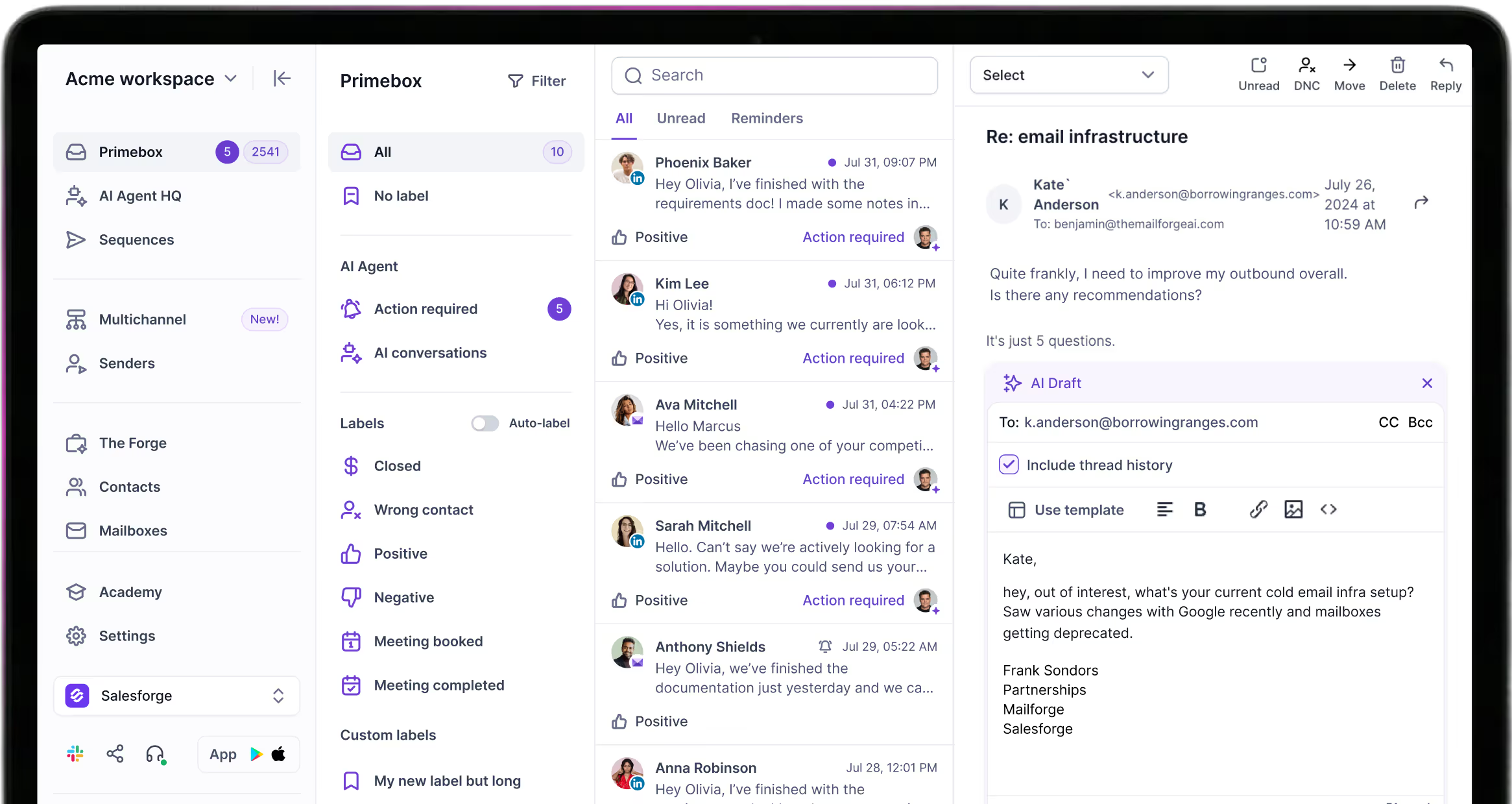
Yes - Agent Frank automates continuous prospecting, verification and multi-channel follow-ups to increase reach and engagement. By combining account research, personalized outreach (emails, LinkedIn, calls) and unified reply handling (primary tab/Primebox), it helps reps capture website visitors, qualify leads, book more meetings and build relationships - producing more pipeline and meetings booked while reducing manual outbound work.
Agent Frank requires a demo and offers consultative onboarding with a dedicated account manager who helps build your knowledge base, configure senders and ramp deliverability. Pricing is scale-oriented (example from the text: from $599/mo for 1,000 Active Contacts with annual discounts); infrastructure addons (mailbox/ESP options) are additional. No free trial was noted - demos and account setup are the primary sign/entry points for teams that want predictable ramp and support while they scale.
Agent Frank personalizes outreach via prospect websites, blogs, LinkedIn posts and your uploaded documents to write tailored sequences and follow-ups. SDRx focuses on deep account research through a large prospecting database and CRM/LinkedIn pulls to create ICP lists. Agent Frank’s one-platform loop continuously finds the right prospects, enriches contact data (emails, phone numbers) and powers multi-channel engagement so reps can engage, call, or power-dial leads and advance conversations through the sales process.