TL;DR - If your priority is scaling multi-channel outreach with a single, centralized workflow, deliverability-first infrastructure, and a tool that supports unlimited sending accounts and reply management out of the box, Salesforge is the platform I’d pick.If your organization involves complex sales cycles and needs enterprise analytics, long-running account plans, and strong conversation intelligence, both Salesloft and Outreach are catered towards that.
Introduction
I set out to evaluate three prominent tools in the cold outreach space: Salesloft, Outreach and Salesforge. I pit them head-to-head across a set of practical and relevant criteria I use when picking a cold outreach tool, such as pricing, multi-channel outreach capabilities, deliverability and sender reputation, personalization, customer support and resources, scalability, campaign management, and more, to help you pick the right option for your business.
Comparison Table
Comparison Table
Criteria
Salesforge
Salesloft
Outreach
Pricing
Starts from $48/mo/company
Contact for pricing
Contact for pricing
Free Version / Trial
14-day free trial
x
x
Team Usage
Unlimited LinkedIn senders, mailboxes, shared workspaces and seats with Growth plan ($96/mo)
Major CRMs, API, Zapier, webhooks, Make, Clay, Sendspark, RB2B
Major CRMs, API, Zapier, webhooks, Make, Clay, Sendspark, telephony
Salesforge, Outreach and Salesloft: Sales Outreach Tool Key Features At A Glance
From my experience:
Salesloft is a revenue orchestration platform built around analytics, and AI workflows. It focuses on aligning sales engagement with pipeline management. It has mature cadence features and an analytics layer intended to boost sales team productivity and translate engagement data into actions, with its focus being centered more towards enterprise-sized companies.
Outreach is an AI Revenue Workflow Platform that spans prospect engagement, conversation intelligence, and deal management. The company surfaces revenue intelligence to help reps and managers prioritize deals and forecast more accurately, though it's similarly focused towards teams running larger-scale operations and wouldn't be as approachable for smaller teams.
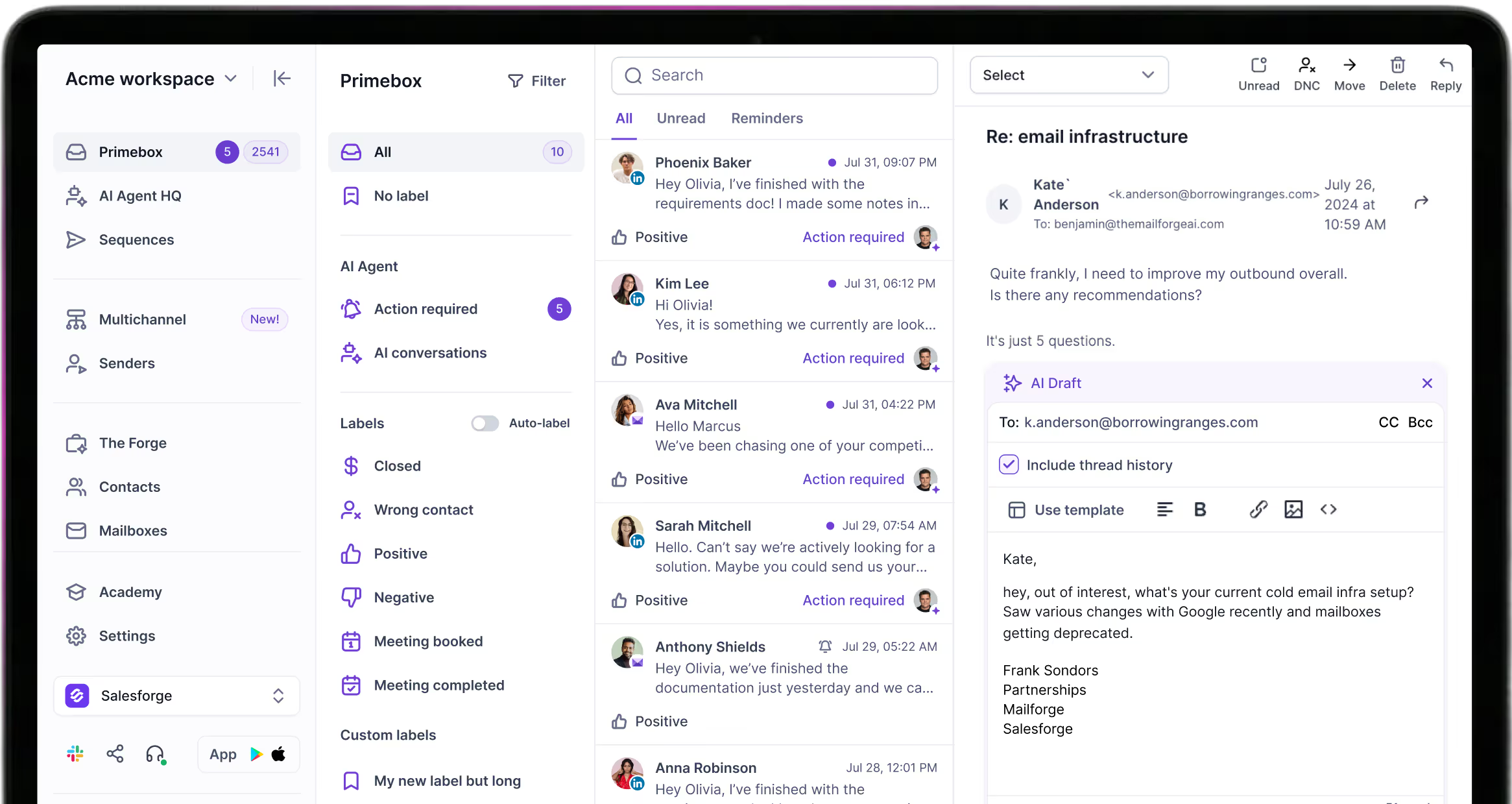
By contrast, Salesforge is the perfect central outreach stack for teams of all sizes. It combines multi-channel sequences, unlimited mailboxes and LinkedIn senders, state-of-the-art deliverability capabilities, several proprietary infrastructure options, and even an optional AI SDR (Agent Frank) for finding, qualifying and reaching out to leads - all in my sleep. Hands-on customer support are available 24/5 and the unified inbox (Primebox) helped me treat replies consistently across channels, which reduced manual triage as well.
Pricing Plans & Free Trials - Which Tool Provides The Highest & Quickest ROI?
Salesforge provides 2 plans oriented around outreach scale and a 14-day free trial (with 2 free months granted when billed annually):
$48/mo for Pro plan (you get: 1000 active contacts in sequence, 5000 messages/mo, 100 email validation credits/mo, 100 personalization credits/mo, unlimited mailboxes, unlimited contact storage, free premium warm up via Warmforge, unlimited workspaces, connect unlimited mailboxes, a unified inbox (Primebox), mailbox rotation, dynamic IPs, live chat support and more)
$96/mo for Growth plan (you get: 10x the credits from the Pro plan, unlimited seats, A/B testing, personal onboarding, API access, 100 social action credits/month, multi-language sequences, Primebox AI reply crafting, ESP matching, access to a massive knowledge base and more)
Salesloft requires contacting sales for pricing information, though it's likely their pricing doesn't go lower than triple digits.
Outreach's pricing is also quote-based, not published openly, and likely doesn't go below triple digit amounts.
Multi-Channel Outreach
When I talk about sales engagement, the ability to reach buyers across channels and keep engagement data in one place is critical for modern sales processes. Complex sequences often require multiple touchpoints, and each tool tackles it differently.
Salesforge supports email + LinkedIn sequences natively. It also offers unlimited LinkedIn senders, unlimited mailboxes, unlimited seats, and even unlimited shared workspaces. Salesforge's unified reply inbox (Primebox) made it incredibly easy for me to keep a single workflow across both channels, with the additional perk of adding AI touches to streamline the process further.
Salesloft supports a broad set of channels - email, calls, SMS, LinkedIn. If your playbook relies on phone steps and manual call coaching inside the same flow, Salesloft handles that cleanly. Salesloft's Cadence automates routine tasks and keeps a consistent sales cadence across the team.
Outreach positions itself as a revenue workflow platform that emphasizes orchestration across prospect engagement and customer retention. Their platform is built for sellers who want engagement with forecasting and unified revenue insights, while also supporting multi-channel cadences through LinkedIn, email and phone.
Personalized Outbound Strategy
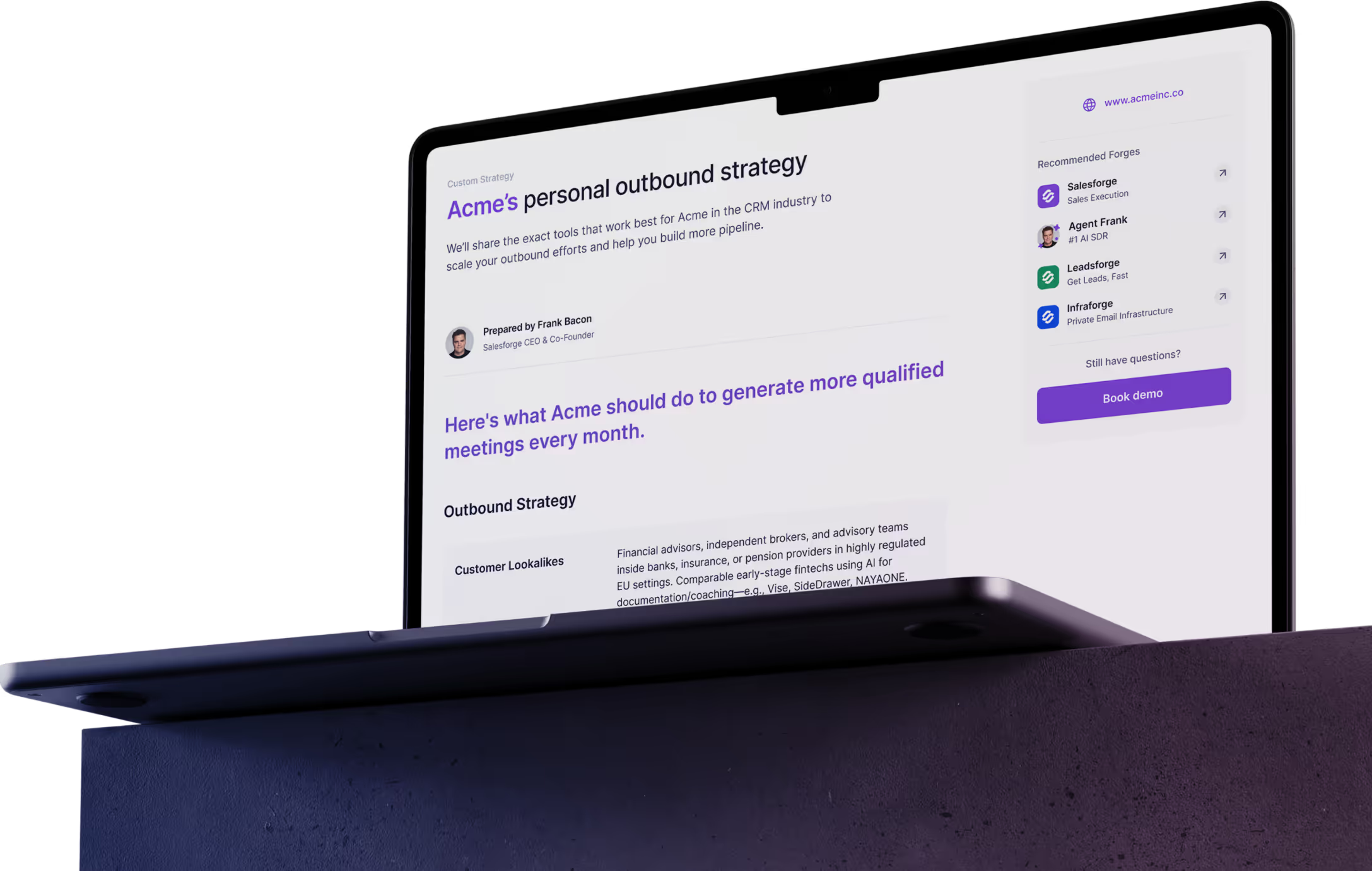
Get The Right Outbound Strategy In Minutes
Enter your email to get a custom plan & stack recommendation for your
business
It's being carefully crafted by AI
Please check your mailbox in 5 minutes
Deliverability & Proprietary Infrastructure
Deliverability is the single biggest hidden cost of cold email marketing. If your emails land in spam, nothing else matters. This is one area where Salesforge differentiates itself:
And more. Building sender reputation gradually while spreading volume across addresses and IPs to avoid single-mailbox throttles or sudden reputation hits is crucial for a scaling business. And that's paired with proprietary infrastructure options:
Or your team can connect custom infrastructure if they so choose
Those infrastructure features reduce the risk of landing in spam and make multi-channel outreach more reliable, especially when you have a leads database and want to integrate email at scale.
Salesloft offers an extensive marketplace and partner ecosystem designed to let enterprise teams assemble a comprehensive suite of external tools - everything from conversation intelligence to intent providers - into a revenue orchestration system.
But Salesloft's deliverability model is primarily suitable only for massive enterprise teams that need predictive analytics, deep integrations and pipeline management across many systems, and can afford it. It assumes you will leverage other specialist platforms as part of a larger proprietary or semi-proprietary tech stack.
Outreach I found to follow similar principles when it comes to deliverability. It provides best-practice guidance and third-party tools to optimize sending behavior as part of its enterprise playbooks, but is also suitable only for teams running large-scale operations.
If your core objective is maximizing steady inbox placement with a setup that removes the need for manual warm-up and maximizes deliverability to the fullest potential, I found Salesforge’s model to be perfect.
Scaling, Unlimited Mailboxes & Unlimited Senders
Running campaigns for multiple clients or multiple sales reps means juggling many email accounts, avoiding cross-sender reputation damage, and often rotating senders.
Salesforge advertises unlimited mailboxes and unlimited LinkedIn senders for the Growth plan, which starts at $96/mo. This removes many constraints and lets me add mailboxes for each sales rep, mailbox per client, or dedicated mailboxes per campaign affordably.
For agencies managing multiple client accounts, that means they can scale without creating a big vendor bill per new mailbox.
Moreover, Salesforge also offers unlimited shared workspaces and seats.
Also a great feature I had access to is the Primebox - a unified inbox with consolidated replies - which simplifies reply triage when dozens of senders are in flight.
Both Salesloft and Outreach are built with enterprise scale in mind. They lean into governance, role controls, and deep integrations so that revenue organizations can map both seller activity and deal state back into a single source of truth. That said, those enterprise strengths come with practical costs:
Enterprise platforms frequently tie advanced features to specific plans or add-ons and often assume a seat/licensed user model for full access. That creates an economic headwind when you want to let dozens of non-core contributors run mailboxes or senders (Salesforge even calls out “forget about seat-based pricing,” which highlights the different approach).
More features and integrations equals more time RevOps spends configuring field mappings, automation rules, and role permissions. Salesloft’s own content about tech-stack consolidation argues that unnecessary complexity in the stack creates hidden soft costs. Of course this means time spent on integrations and troubleshooting reduces net value.
Outreach and Salesloft are powerful when run by large, experienced teams, but that means more people and processes to maintain. If your goal is rapid expansion of account coverage with minimal admin, that’s a trade-off to accept - it’s not a bug, just a different product philosophy.
Ease of Use & Simplicity
I found Salesforge to be the perfect tool for frictionless growth:
I found the interface and sequence builder to be straightforward - the sender model removes many permission/seat decisions that otherwise block pilots.
Free, unlimited built-in warm-up and reply consolidation also reduces coordination.
The analytics emphasize only the most important things, such as which cadences convert into meetings, which is exactly what outbound SDRs and managers need to optimize playbooks.
Salesloft, on the other hand, feels polished, but very heavy:
Salesloft’s cadence and analytics are excellent at surfacing coachable moments and enforcing consistent sales processes, but that's as far as ease of use goes from my experience.
The polish comes with more configuration. Conductor/analytics yield more value after initial setup, but it's a much steeper ramp for teams expecting plug-and-play simplicity.
For organizations with a dedicated enablement function, this tradeoff pays off - for lean teams it slows adoption.
Outreach, from my experience, is powerful, but includes a very steep learning curve:
Outreach gives strong conversation intelligence and deal linkage, which helps revenue operations and forecasting.
Its breadth increases the number of knobs to set (Deal Agent rules, workflow triggers, etc.). For smaller teams or fast pilots, that creates friction and longer rollout timelines.
Mobile and advanced features are available, but they add to the interface complexity that first-time users must learn, as well as other UI elements that many users might never find necessary.
Who should pick which tool?
Pick Salesforge if you run campaigns that need unlimited email accounts/LinkedIn senders, want unified reply management, want a deliverability-first workflow with unlimited free warm-up, or simply want an affordable option for smooth cold outreach. It’s my pick for teams and agencies of all sizes managing multiple clients and sales teams that need high inbox placement across many senders.
Pick Salesloft if your priorities are enterprise analytics and guided workflows, tight CRM governance and deep integrations, and a balance between automation and controlled human execution for complex sales cycles. Consequently, I found Salesloft to best fit massive sales teams that can afford the steep learning curve and a dent in their wallets.
Pick Outreach if your problems are around revenue orchestration and you want engagement data tied directly to forecasting, deal management, and renewals, you need automation for retention and expansion alongside prospecting, and you want advanced conversation intelligence to feed revenue intelligence and pipeline accuracy. From my perspective, Outreach suits organizations seeking an all-in-one revenue execution platform rather than a tool whose main focus is outreach.
Smartlead vs Instantly vs Salesforge: My Final Verdict
After comparing feature sets, deliverability tooling, campaign building UX, agency workflows, customer care, and pricing, my choice for the go-to tool for cold outbound would be Salesforge if your primary needs are:
Scaling outreach across unlimited email accounts and LinkedIn senders,
Seamless consolidated reply handling with the Primebox,
1. How does Salesforge compare to Salesloft vs Outreach as the right sales engagement platform for mid-market sales teams?
Salesforge emphasizes multi-channel sales outreach platform features (email + LinkedIn), unlimited mailboxes, inbox rotation, and built-in deliverability - making it ideal for mid-market sales teams that want to scale account coverage without complex seat licensing. Salesloft vs Outreach target larger sales teams with deep conversation intelligence, lengthy multi-step sales cadences, and enterprise-grade analytics. For sales leaders wanting simpler user interface, faster ramp, and sales automation to streamline sales processes across the entire sales organization, Salesforge often strikes the best balance of capability, price, and speed-to-value.
2. Can Salesforge truly streamline sales processes and replace a sales development platform like Salesloft or Outreach?
For many use cases yes - Salesforge handles campaign management, multi-channel cadences, follow-ups, bulk upload from your lead database, API access, and automated sales tasks. It reduces friction for sales teams to optimize outreach campaigns and scale account coverage without the steep learning curve typical of enterprise sales execution platforms. If your priority is fast deployment, easier sales automation, and reducing RevOps overhead, Salesforge can replace heavier sales tools. If you need deep coaching, call analytics, or advanced forecasting, both Outreach and Salesloft can shine.
3. How does Salesforge’s reporting help sales leaders measure sales performance versus the actionable deal insights from Outreach or Salesloft?
Salesforge provides campaign-level analytics, advanced reporting on opens/replies/conversions, and dashboard views that link outreach campaigns to meetings and pipeline - helping sales leaders and customer success teams see which cadences drive results. Outreach delivers deeper actionable deal insights tied to forecasts; Salesloft focuses on cadence health and rep coaching. Use Salesforge when you want clear, usable sales performance metrics that drive iteration across multiple campaigns without the heavy configuration needed for enterprise revenue orchestration.
4. Will Salesforge protect deliverability and master inbox hygiene when scaling multiple email accounts and follow-ups?
Yes - Salesforge’s deliverability features (unlimited email warm-up, inbox rotation, dynamic IPs, and spam/placement tests) are built to avoid spam folders and reduce triggers. Its centralized master inbox consolidates replies so sales teams can triage at scale, while built-in verification, sensible warm-up pacing, and multi-mailbox rotation let you run many campaigns and unlimited email follow-ups without collapsing sender reputation. That infrastructure helps you scale account coverge while keeping messages landing in primary inboxes.
5. How well does Salesforge fit with my existing tool stack and the mobile needs of sales teams compared to Outreach vs Salesloft?
Salesforge offers API access and native integrations to sync lead data with CRMs and external tools, so it plugs into your existing tool stack with minimal glue work. It includes a mobile app for on-the-go reply handling and sales tasks, which helps distributed sales teams stay productive. Both Outreach and Salesloft also integrate widely - Outreach delivers deep revenue orchestration and Salesloft strong enablement tooling - but Salesforge focuses on rapid sales automation, simpler UI, and lower admin burden for sales leaders who want to mobilize reps quickly.
Book more meetings on autopilot
Set up in minutes. No per-seat pricing. No commitment.
I dug through Workflows.io's five services, its $4K to $12K pricing bands, ten published case studies, and how it stacks up against certified outbound alternatives.
I dug through corebits.io, the gtm.corebits.io subdomain, and every case study across their three engines to give you an honest read before you book the discovery call.
Read this Vantage Profiles review for a clear look at its LinkedIn account rental service, pricing, identity risks, customer feedback, and whether it is worth using.



.jpg)