Compare Tools

Salesforge vs Woodpecker: Outreach Automation Tool Comparison

Choosing the right cold outreach platform is a make-or-break decision for teams that send cold outreach campaigns. On one side you have Salesforge - a newer but notable multi-channel outreach tool that has taken the market by storm - and on the other, Woodpecker - a mature cold outreach platform with a long track record. This comparison unpacks everything important when choosing a cold outreach tool: from deliverability, campaign design and automation, to analytics and scaling approachability.
Let's compare:
Pricing
Starts at $48/month
Starts at $29/month
Free Trials
14-day free trial
7-day free trial
Outreach Channels
Email + LinkedIn (phone planned in the future)
Email (LinkedIn & phone as paid add-ons)
Team Features
Unlimited senders, mailboxes, workspaces and seats (Growth plan)
Only unlimited mailboxes & seats
Automated Messaging
Automated LinkedIn and email sequences, A/B testing, multi-source AI hyper-personalization, automatic AI writing
Multi-step automated email sequences, follow-ups, condition-based branches, A/B testing, personalization tokens, AI writing
Analytics & Reporting
Advanced analytics (real-time, channel-specific reporting, A/B tests, campaign metrics, reply tracking, deliverability monitoring)
Advanced analytics (real-time, reply tracking, A/B tests, deliverability monitoring)
Email Deliverability
Free proprietary premium warm-up via Warmforge, dynamic IPs, mailbox rotation, ESP matching
Warm-up, email verification, monitoring, adaptive sending
Integrations
Forge Stack, major CRMs, API, Zapier, Make, webhooks, Clay
Some major CRMs, API, Zapier, webhooks, Make, Clay
Whitelabel
AI SDR
Support
24/7 email and live chat support, extensive knowledge base, large Slack community, weekly AMA sessions, video tutorials
Email and live chat support, knowledge base, Slack community, tutorials, webinars

For a thorough understanding of what each option offers, a simplified comparison table isn't enough to grasp all intricacies that come with each tool, so let's dive deeper into what makes Woodpecker and Salesforge unique.

Salesforge vs Woodpecker: Cold Email & LinkedIn Outreach Tool Overview

Salesforge is built around high-scale, advanced deliverability, multi-channel email outreach and sales automation, while Woodpecker focuses primarily on reliable cold email sequences.

  • Salesforge shines when it comes to automated LinkedIn/social sending (Salesforge includes dedicated social-action credits and automated social actions, Woodpecker supports LinkedIn primarily as manual tasks or via integrations/add-ons), premium deliverability (including unlimited free warm-up via Warmforge), plan-included validation + personalization credits, unified sending tools & advanced consolidated reply inbox.
  • Woodpecker is also strong with its strong focus on email deliverability, as well as adaptive sending, and reply detection for pure cold email sequences. It’s a mature choice for teams prioritizing straightforward email marketing/outreach sequences and deliverability health, with other channels functioning more as optional additions rather than core channels.

Pricing Structure & Free Trials

Woodpecker provides multiple plans oriented around outreach scale and a 7-day free trial (save ~33% with annual billing):

  • $29/mo for Starter plan (you get: 500 contacted prospects, 6,000 emails/mo, 2,000 stored prospects, 2 free warm-ups)
  • $188/mo for Growth plan (you get: 10,000 contacted prospects, 120,000 emails/mo, 40,000 stored prospects, 20 free warm-ups)
  • Add-ons: LinkedIn outreach ($29/mo per LinkedIn account), Warm-up top-ups ($5/mo per inbox), Agency panel ($27/mo per active client), Whitelabel reporting app ($5/mo per client), API/Webhooks/MCP & integrations as an add-on ($20/mo) and more)

Salesforge provides 2 plans oriented around outreach scale and a 14-day free trial (with 2 free months granted when using annual billing):

  • $48/mo for Pro plan (you get: 1000 active contacts in sequence, 5000 messages/mo, 100 email validation credits/mo, 100 personalization credits/mo, unlimited mailboxes, unlimited contact storage, free premium warm up via Warmforge, unlimited workspaces, connect unlimited mailboxes, a unified inbox (Primebox), mailbox rotation, dynamic IPs, live chat support and more)
  • $96/mo for Growth plan (you get: 10x the credits from the Pro plan, unlimited seats, A/B testing, personal onboarding, API access, 100 social action credits/mo, multi-language sequences, Primebox AI reply crafting, ESP matching, access to a massive knowledge base and more)

Key Focus

When comparing key aspects, Woodpecker and Salesforge slightly differ in priorities:

  • Woodpecker’s public features make it clear they provide limited free email verification, limited free warm-up, condition-based campaigns, inbox rotation, and unlimited follow-ups - tools built for safe, measurable cold email.
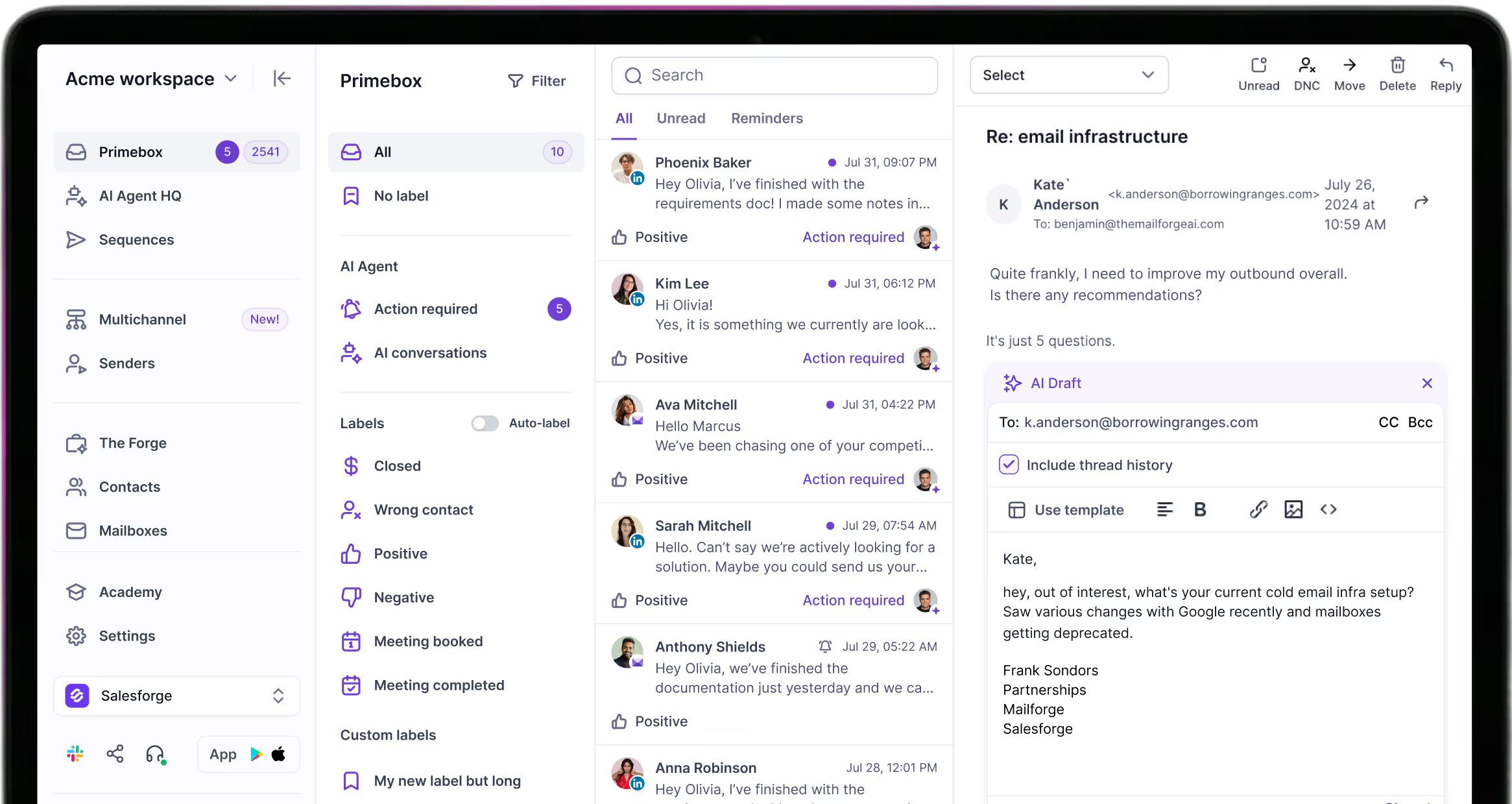
  • Salesforge additionally emphasizes: deliverability via Warmforge, unlimited LinkedIn senders, unlimited mailboxes, unlimited shared workspaces, multi-channel outreach (email + LinkedIn, with phone outreach coming soon), a consolidated reply inbox (Primebox), and a stack of Forge tools (Mailforge, Infraforge, Primeforge, Leadsforge) that streamline every single sales outreach step.

The practical difference is that Woodpecker is very focused on the cold email campaign experience itself - templates, subject lines, verification, and warm-up - while Salesforge bundles multi-channel campaign orchestration with a whole array of capabilities.

Email Deliverability & LinkedIn Sender Safety

Deliverability is the single most important technical constraint for cold email. If your outreach lands in spam folders, none of your subject lines, email copy, or follow up email strategy matters.

Salesforge puts deliverability at the center with:

  • Unlimited free warm-up via Warmforge
  • Dynamic IPs
  • Rotating mailboxes
  • Spam checkers
  • Placement tests
  • ESP matching
  • Mailbox health monitoring
  • Deliverability metrics

And that's paired with proprietary infrastructure options:

That design reduces the friction of scaling outreach across many email accounts and domains, and it ties into sender reputation protections like per-mailbox pacing and dynamic sending patterns.

Woodpecker also invests heavily in deliverability - with warm-up & recovery, inbox rotation, adaptive sending, and domain audit tools that help you stay clear of spam filters - but their deliverability capabilities are noticeably less robust as Salesforge's.

Campaign Building & Personalization

Both platforms support merge tags and personalization tokens so your cold emails feel like one to one conversations rather than broadcast blasts.

  • Woodpecker’s interface and campaign workflows make it easy to add merge tags, set condition-based campaigns, and design follow-up email sequences that stop when prospects reply - a practical set of features that improves response rates and reduces unnecessary sends.
  • Salesforge leans into advanced personalization at scale with multi-source AI-driven hyper-personalization and a focus on crafting outreach that ties to the prospect’s pain points. Salesforge’s stack further helps teams layer data-driven personalization into message copy and subject lines.

Message Automation

Both tools excel at automating cold email sequences and one-to-one conversations, but they come at automation from different angles.

  • Woodpecker focuses on classic sequence builders (up to multi-step campaigns, A/B testing, condition-based followups and reply detection) that make running cold email campaigns and email marketing style sequences straightforward + features fairly robust deliverability capabilities (although with limits).
  • Salesforge also automates sequences but bundles advanced AI hyper-personalization and an always-on automated warm-up engine. Salesforge emphasizes automation that not only writes and sequences highly personalized messages but actively guarantees the messages land in the primary inbox.

Multi-channel Outreach

Salesforge and Woodpecker both support multi-channel outreach, but they take different approaches and trade-offs for teams running cold email campaigns.

  • Woodpecker is email-first with pragmatic multi-channel touches: it adds LinkedIn manual tasks (connection requests, messages, profile visits or InMails), call/SMS steps and CRM integrations inside sequences, but typically expects you to attach or pay per LinkedIn slot and to manage some infrastructure externally.
  • Salesforge pitches an all-in-one stack: email + LinkedIn in unified sequences, plus integrated deliverability and sending infrastructure (Mailforge/Infraforge/Primeforge) and robust built-in deliverability capabilities so teams can scale without stitching separate tools together.
  • Salesforge also advertises unlimited mailboxes and unlimited LinkedIn senders, a centralized Primebox that consolidates email and LinkedIn messages, and an optional AI SDR (Agent Frank) that fully automates everything from prospecting to booking meetings.

If your priority is simple, email-first outreach, Woodpecker gives a straightforward path. If your priority is outreach that focuses on both email and LinkedIn, limitless scale, a convenient unified inbox and robust proprietary deliverability capabilities, Salesforge bundles those capabilities natively.

Scaling

Woodpecker scales by letting teams add unlimited mailboxes, inbox rotation and adaptive sending to spread load and protect sender reputation.

Salesforge approaches scale to an even further extent: it couples rotation + warm-up with unlimited LinkedIn senders, unlimited mailboxes, unlimited shared workspaces, even unlimited seats. Salesforge also offers proprietary infrastructure: Mailforge/Infraforge/Primeforge help create and manage many domains & mailboxes + automate DNS/warmup so users can run high-volume cold email campaigns without manually provisioning mailboxes.

Integrations

Salesforge and Woodpecker both play well with external stacks, but their integration philosophies differ.

Woodpecker offers native connectors to major CRMs and tools (HubSpot, Salesforce, Pipedrive, Close, Zoho, Slack) and a native Google Sheets import, plus deep Zapier support so you can link to thousands of apps. Woodpecker’s integration surface is pragmatic and heavily Zapier-driven.

Salesforge promotes a broader integrations story:

Salesforge supports many more native integrations, but one important distinction is the proprietary Forge Stack, which keeps prospect data, campaign history, and inbox conversations aligned so that when a lead moves to opportunity stage the handover is seamless. If you need richer programmatic control, Salesforge surfaces those integration options as key features.

Ease-of-use & User Interface

  • Woodpecker is known for a clean UI: sequence builder, templates, centralized inbox and simple deliverability checks make setup fast for teams used to Gmail/Outlook flows.
  • Salesforge aims for a similar user experience but nudges you into an all-in-one workflow (lead search, personalized outreach, warm-up and inbox-placement monitoring), while still making everything intuitive and easy to digest.

Woodpecker is straightforward and battle-tested, but Salesforge adds tighter end-to-end control over sender reputation and infrastructure.

Use Cases

  • Different teams have different priorities. Solo users and small teams often want an basic plan with a shallow learning curve - Woodpecker is attractive here, and their free email verification reduces risk from invalid addresses (Salesforge also offers a free email verifier).
  • Agencies value tools that can manage multiple clients and offer white-label - Woodpecker’s agency plan is designed for that workflow.

Salesforge, on the other hand, immediately caters to teams of all sizes.

  • Enterprise teams and growth engines often prioritize deliverability at scale, and orchestration across email + LinkedIn - that’s Salesforge’s sweet spot.
  • For teams planning multiple concurrent client campaigns and looking to minimize manual deliverability work, Salesforge’s bundled tooling (warm-up, Leadsforge enrichment, Mailforge/Infraforge/Primeforge convenience) streamlines scaling.

Final Verdict: If Cold Emails Reach Inboxes... Is Multi-Channel Outreach Still Superior?

Both tools are strong, but you should pick based on what matters most:

If you want a mature cold email tool with free email verification, straightforward basic features, and an agency panel for larger clients, Woodpecker is a reliable choice.

If your priority is to keep cold emails reaching inboxes at scale, while removing manual deliverability work, automating AI hyper-personalization, running many simultaneous client campaigns or mailboxes, and tying email to multi-channel outreach, Salesforge offers just what you're looking for.

Wanna hear more from the Forge?

Start a free trial and let's fry some 🥓bacon together!

Test out AI-powered personalization at scale for more effective outreach & more closed deals.
Thank you! Your submission has been received!
Oops! Something went wrong while submitting the form.

Frequently asked questions

If we don’t answer your question below, please contact us via chat

How does Salesforge compare to Woodpecker for cold email deliverability?

Salesforge emphasizes deliverability with Warmforge (unlimited free warm-up), dynamic IPs, mailbox rotation and ESP matching so cold emails reach inboxes rather than the spam folder. Woodpecker (including Woodpecker co) focuses on warm-up and adaptive sending but has more limited free warm-up. If avoiding spam folders and preserving a positive reputation is critical, Salesforge is built around that goal.

Can Salesforge handle multichannel outreach and LinkedIn better than Woodpecker?

Yes - Salesforge is natively multichannel outreach (email + LinkedIn) with unlimited LinkedIn senders and a unified inbox for one to one conversations. Woodpecker supports LinkedIn outreach primarily via paid add-ons or integrations, so initial outreach that mixes email and social actions is more seamless in Salesforge.

Is Salesforge a better choice for scaling client campaigns and active clients than Woodpecker?

Salesforge targets large-scale client campaigns with unlimited mailboxes, workspaces and seats, aiding agencies and active clients. Woodpecker offers agency features and a Woodpecker account model, but sending limits Woodpecker enforces (per plan/add-on) can constrain volume. For many concurrent client campaigns and high throughput, Salesforge’s stack simplifies scale.

How does Salesforge personalize outreach compared to Woodpecker’s cold email plan?

Salesforge uses multi-source AI hyper-personalization to reach prospects in such a personalized way that messages read like one to one conversations. Woodpecker (Woodpecker co) offers merge tags and some AI plus free email verification to avoid invalid addresses. Salesforge emphasizes scaled hyper-personalization and automated warm-up; Woodpecker emphasizes safe, tokenized personalization.

What key features and campaign reporting set Salesforge apart from Woodpecker?

Key features: Salesforge bundles Warmforge, Mailforge/Infraforge/Primeforge, advanced channel-specific analytics, campaign performance metrics, A/B tests and a consolidated Primebox for email campaigns and outreach efforts. Woodpecker co focuses on straightforward cold email plan elements (verification, warm up Woodpecker, reply detection). Both track campaign performance and opt out handling, but Salesforge leans toward multichannel orchestration and deliverability-centric reporting.