
Personalized Outbound Strategy
Get The Right Outbound Strategy In Minutes
Enter your email to get a custom plan & stack recommendation for your business
It's being carefully crafted by AI
Please check your mailbox in 5 minutes


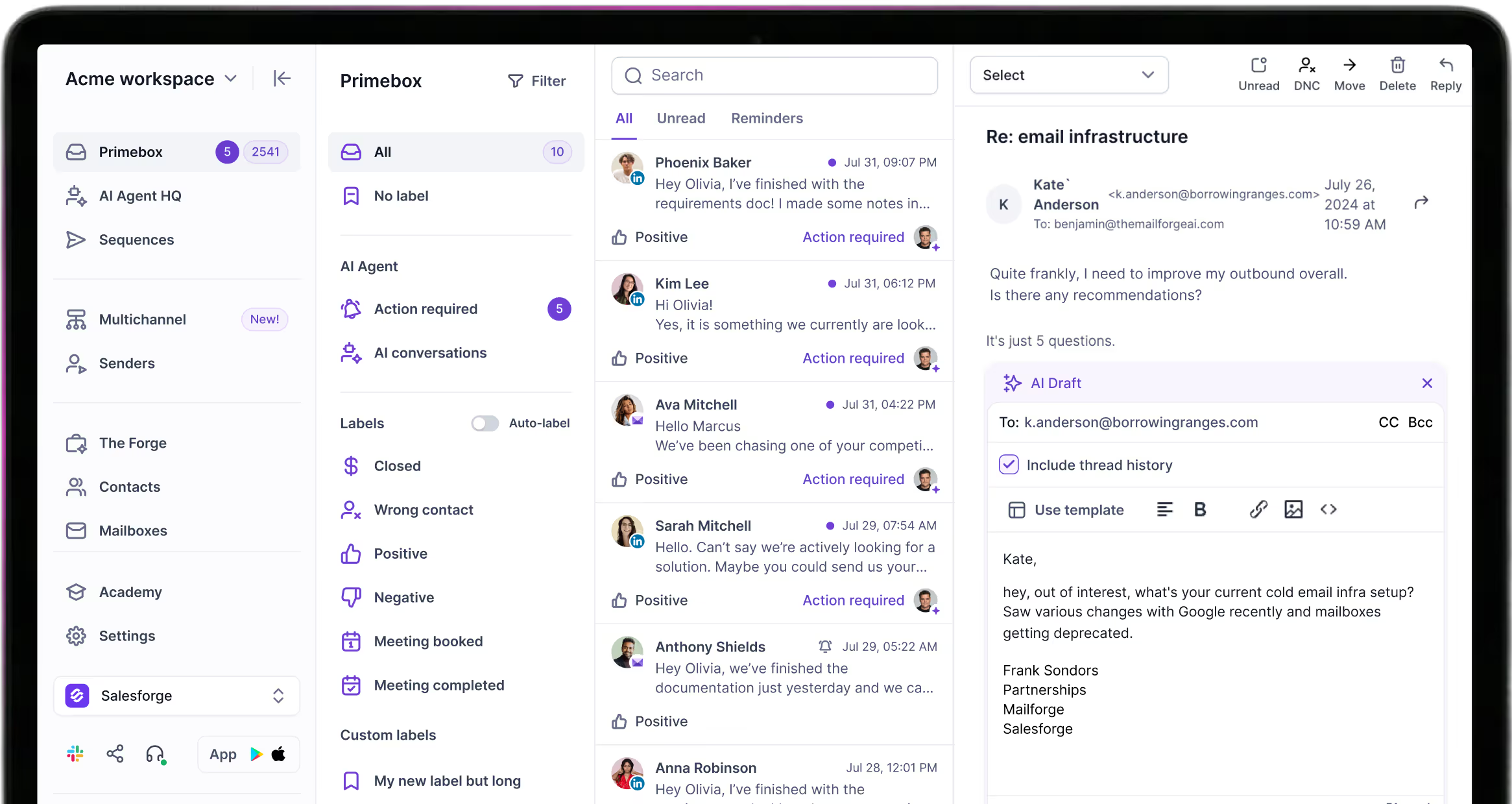
For a thorough understanding of what each option offers, a simplified comparison table isn't enough to grasp all intricacies that come with each tool, so let's dive deeper into what makes SalesTools and Salesforge's Agent Frank unique.
Both products position themselves as AI sales agents that run 24/7 to augment or replace manual SDR work, but the practical differences come down to what gets automated and how the automation connects to your sales process.
Agent Frank, built by a former Googler and VP of sales, is a turnkey solution within a tightly integrated suite (The Forge Stack) - designed to run on auto-pilot and reduce all manual tasks that typically burden SDRs.
Doubtful? Let Agent Frank's results speak for themselves:

SalesTools emphasizes breadth of data, buyer intent, deep research agents, and visitor tracking - features designed to increase the intelligence feeding the outreach and to make personalization and account selection more surgical.
Both approaches matter, but Agent Frank focuses more on the entire prospecting and outreach layer to ensure quality messages actually reach prospects and lead to meetings with appropriate ICPs.
Agent Frank provides flexible pricing oriented around outreach scale. Pricing is charged by Active Contacts (the number of prospects the Agent is processing at any given time), and annual billing includes 2 months free. There is no free trial and demos are required before purchase.
Note that infrastructure to process those contacts via email is not included in this base price. The Salesforge Stack offers multiple infrastructure options based on your budget/needs, so you don't need to stitch third-party products to make it work. The best options for Agent Frank include:
The Forge team will help set up the mailboxes and, additionally, the Mailforge (shared IP) and Primeforge (Gmail and Outlook) email infrastructure options are also available. Additionally, teams can connect their own mailboxes from other providers if desired.
SalesTools prices around outreach scale using Platform Credits. Annual billing saves 20% (roughly two months free), a free trial is offered from the marketing flow.
Both pages emphasize automated prospect discovery and continuous prospecting, but they arrive differently.
That data depth is ideal for teams that just need to flood the top of funnel with accounts, to run sophisticated account-based outreach, or to pivot rapidly into new verticals.
The crucial practical difference is about control and results: Salesforge emphasizes that Agent Frank uses the internal Forge Stack to keep prospecting tightly coupled with deliverability and message execution.
For many teams the problem with big-data prospecting is not necessarily in finding leads, but converting them - and conversion hinges on inbox placement, cadence timing, and contextual personalization.
SalesTools pitches deep research agents that analyze company signals, industry trends and financial health to generate hyper-personalized conversation starters. It touts conversation intelligence and AI-powered analysis to inform messaging and cadence timing.
Agent Frank further focuses on hyper-personalization through its uploadable knowledge base and active prospect signals.
Agent Frank also has adjustable tones and goals, and the co-pilot mode also lets humans review messages before sending, which is important for teams that want the benefits of personalized outreach without the risk of brand tone or informational errors.
Deliverability and infrastructure are where differences become operationally decisive. Deliverability is the linchpin of cold outreach success - a brilliant sequence is worthless if emails land in spam - and this is one area where Agent Frank intentionally differentiates itself.
And more. Building sender reputation gradually while spreading volume across addresses and IPs to avoid single-mailbox throttles or sudden reputation hits is crucial for a scaling business. And that's paired with proprietary infrastructure options:
Those infrastructure features reduce the risk of landing in spam and make multi-channel outreach more reliable, especially when you have a leads database and want to integrate email at scale.
By contrast, SalesTools promotes a broad platform with visitor intelligence and intent data but does not present the same kind of vertically integrated mail infrastructure or a managed warmup service.
For sales teams or lead generation agencies focused on large scale operations and high-volume cold outreach, Agent Frank’s model minimizes the operational burden of maintaining email metrics, domain health, and warm-up cycles so teams can scale sends across many mailboxes with less risk.
Enter your email to get a custom plan & stack recommendation for your business
Please check your mailbox in 5 minutes
Both platforms automate aspects of reply handling and meeting setup, but they frame those automations differently.
Practically, Agent Frank’s strength is that reply handling sits inside a managed system with mailbox controls, warm-up and overseen cadence execution.
That means Agent Frank reduces the common pain point of lost replies due to fragmented stacks or misconfigured mailboxes and pairs reply-handling with a human support layer to maximize pipeline yield.
Customer support is a practical part of the business case for any AI SDR - support quality affects onboarding speed, how reps adopt the tool, and how quickly you can scale outreach without damaging sender reputation or interrupting the outreach process.
SalesTools provides help and documentation, and the SalesTools University, but their site presents a more self-serve, data-driven onboarding posture.
Salesforge's approach further reduces the manual tasks sales teams often struggle with - no separate deliverability vendor, fewer manual data entry steps, and a partner focused on ironing out initial list hygiene and infrastructure.
Besides that, Agent Frank customers also get:
For growing sales teams and lead generation agencies that prefer to shift heavy operational overhead away from internal staff, Agent Frank’s model is a strong fit.
They offload the manual tasks that consume SDR time and let reps focus on higher-value activities like closing deals and handling qualified leads.
Both SalesTools and Agent Frank deliver compelling capabilities:
SalesTools offers scale, intent data and deep research agents for teams that want to invest in highly targeted, data-driven outreach and visitor intelligence.
Agent Frank offers a more turnkey, execution-first AI SDR:
If your pain points are missing replies, poor inbox placement, or a steep learning curve across multiple sales tools, Agent Frank’s integrated stack and human support reduce the risk and streamline the path from lead to meeting to closed deal.
Agent Frank is a purpose-built AI agent that automates continuous prospecting, hyper-personalized messaging and personalized follow ups while integrating seamlessly with your CRM and outreach campaigns. Its integrated deliverability stack (warm-up, rotating mailboxes, IP management) helps improve inbox placement so revenue teams see higher response rates and better conversion rates. Sales reps spend less time on manual research and more on closing deals, so the platform directly streamlines lead generation and pipeline growth for your company and team.
Agent Frank prices by Active Contacts and offers tiered and enterprise plans with custom quotes for large-scale needs. Annual billing provides savings and the Forge Stack also sells mailbox infrastructure add-ons so teams don’t stitch vendors. The model is built to scale (multiple mailboxes, infra options, deliverability controls) so revenue teams can expand outreach reach and demand. Total cost depends on contacts, platform options and support level; Salesforge provides demos and account managers to produce firm custom quotes.
Yes - Agent Frank supports CRM integration and syncs outreach campaigns, replies, meeting links and contact status so your CRM reflects pipeline activity. Built-in AI reply handlers, routing and Co-Pilot review modes let reps approve or hand off messages, preserving brand tone and reducing errors. That automation streamlines lead qualification, preserves jobs by removing repetitive tasks, and lets sales reps concentrate on higher-value activities like demos and closing deals.
Outcomes vary by ICP, data quality and cadence, but Agent Frank’s combined advantages - automated prospecting, hyper-personalization, and proprietary deliverability infrastructure - are designed to increase response rates and conversion rates more reliably than standalone intent/data platforms. It provides dashboards and mailbox health insights so teams can track pipeline, responses and revenue impact. While no vendor guarantees exact numbers, the platform’s focus is to convert more leads into meetings and ultimately more deals and revenue for your business.
Agent Frank pairs a dedicated Account Manager, 24/7 support, documentation, Slack community and weekly AMAs to surface and resolve issues fast. Co-Pilot mode, message review, and knowledge-base uploads let teams control tone and correct factual errors before sends. Deliverability tooling (warm-up, placement tests, mailbox health) minimizes spam risks that can harm reputation. The platform is positioned to reduce repetitive SDR work - not simply replace jobs - so teams can focus on higher-value selling while support mitigates bad review and operational pain points.